
Summary
Editor's rating
Value for money: depends how much you pay and how often you replace heads
Design: simple, practical, but nothing fancy
Battery life and charging: one of the strong points
Comfort in the mouth and daily use
Build quality and how durable it feels
What you actually get in the box
Cleaning performance: does it actually make a difference?
Pros
- Cleans very well with noticeable smoothness and reduced surface staining compared to basic brushes
- Strong battery life (around 2–3 weeks per charge with normal use)
- Pressure alert and QuadPacer timer genuinely help with better brushing habits
Cons
- High official retail price for a brush with only two modes and no smart features
- Replacement heads are expensive and less easy to find than some competitors

Specifications
View full product page →| Brand | PHILIPS |
A mid-range Sonicare that actually feels like an upgrade
I’ve been using the Philips Sonicare 5500 for a few weeks now, twice a day, replacing an older budget Sonicare and a basic Oral-B rotary brush. I’m not a dentist, just someone whose gums complain when a toothbrush is too rough and who’s tired of products dying after a year. So I went into this with pretty normal expectations: I wanted something that cleans well, doesn’t shake my skull, and doesn’t need charging every three days.
Out of the box, the 5500 feels like a mid-range product. Not cheap, not luxury. The promise is simple: 2 modes, a pressure alert, a timer, and better plaque removal than a manual brush. No app, no Bluetooth, none of that “smart” stuff I never use past week one. That actually suited me; I just want to hit one button and brush.
From the first week, the main thing I noticed was how my teeth felt after brushing. Compared to my old Oral-B rotary, it’s less noisy and the vibration feels smoother. The EasyStart feature is honestly a bit gimmicky but helpful if you’ve never used a sonic brush before; it ramps up the power over the first 14 uses so you’re not shocked by the full intensity on day one.
Is it perfect? No. The brush heads are pricey, there are only two modes, and there’s no fancy charging stand or USB travel charger. But in daily use, it does the core job well: my mouth feels cleaner, and the battery doesn’t constantly nag me. If that’s what you care about, it’s already off to a decent start.
Value for money: depends how much you pay and how often you replace heads
This is where it gets a bit mixed. In terms of performance and comfort, I’d say the Sonicare 5500 is good. It cleans well, battery life is solid, and it’s simple to use. But the official retail price some shops list (often north of £150–£200) is, in my opinion, too high for what it offers: only two modes, no app, one brush head, and a basic charger. At that price, you’re paying a lot for the brand name and not getting many extras.
However, this brush often goes on discount. If you catch it at a reduced price – something more reasonable like the typical mid-range level – then the value starts to make more sense. At a lower price point, the strong cleaning performance and battery life outweigh the lack of fancy features. That’s basically what one of the Amazon reviewers said: they were happy with it at the promo price but wouldn’t have paid full RRP, and I’m on the same page.
Where the value really gets dented is the cost and availability of replacement heads. Official Philips heads are pricey, and you don’t always find them easily in regular supermarkets like you do with Oral-B. You either stock up online or pay a premium locally. There are third-party compatible heads, but quality is hit or miss, so it depends how comfortable you are going off-brand for something that goes in your mouth twice a day.
So, value-wise: if you’re buying it full price and using only official heads, it’s on the expensive side for what it is. If you grab it during a sale and you’re okay hunting for deals on heads, then it becomes a pretty solid mid-range option that gives you good daily results without a ton of bells and whistles.
Design: simple, practical, but nothing fancy
The design is pretty straightforward. The handle is slim, navy plastic, and the surface is smooth but not slippery. I’ve used it with wet hands plenty of times and never felt like it was going to fly out of my grip, but don’t expect grippy rubber or anything. One thing I do like: the power button is hard plastic, not that soft rubber that peels or cracks after a year. My previous brush died exactly because of that kind of rubber button, so this is a small but important upgrade.
The layout is simple: one button, two small mode indicators, and the battery light. Press once to turn on, press again to switch between Clean and White before the cycle starts. After it’s running, you can’t change modes mid-brush without turning it off and back on, which is mildly annoying but not a dealbreaker. Once you pick a mode you like, you’ll probably just stick to it anyway.
The brush head is more of an oval/elongated shape compared to the round Oral-B style. Personally, I find this shape easier for reaching behind the front teeth and along the gum line without feeling like I’m drilling my mouth. It also feels slimmer in the mouth, so you don’t have that bulky, clunky sensation. The downside is that the head design is proprietary and replacement heads are not cheap, especially if you buy the official ones.
In terms of noise and feel, the 5500 has that typical Sonicare high-frequency buzz, but it’s not outrageously loud. It doesn’t feel like a jackhammer in your skull the way some cheaper brushes do. The design overall is very “no nonsense”: it looks fine on the sink, it’s easy to wipe down, and there aren’t any weird grooves or textures that trap toothpaste gunk. It’s not there to impress, it’s just there to work.
Battery life and charging: one of the strong points
Battery life on this thing is honestly one of the best parts. Philips doesn’t shout a specific number in the listing, but in real life use (twice a day, 2 minutes each, mostly on Clean mode), I’ve been getting around 2–3 weeks on a single charge. I charged it fully when I got it, used it daily, and it only started blinking low after a bit over two weeks. That’s perfectly fine for me.
The charging base is the usual Sonicare plastic stand. You just drop the brush on it and it charges inductively. No fiddly contacts to align, no USB-C or anything modern either, which is a bit dated but it works. It’s light, doesn’t take much space, and if you’ve had other Sonicare models, it’ll feel familiar. The downside is that there’s no USB charging option, so if you travel internationally a lot, you’ll be dealing with adapters and the usual plug nonsense.
The battery indicator is simple: a small LED that gives you a rough idea (full, medium, low). When it’s near empty, the brush still runs at full power but warns you enough in advance that you’re not caught mid-trip. I left it without charging on purpose to see how it behaved at low battery, and it didn’t suddenly lose power or die mid-brush; it just gave me some days of warning.
Overall, for everyday life, you’re not chained to the charger. You can realistically leave the base in a drawer and only pull it out every couple of weeks. For me, that’s a big plus compared to cheaper brushes that need charging every few days and end up permanently living on the sink, taking space and looking messy.
Comfort in the mouth and daily use
Comfort-wise, this brush is pretty solid. The handle is light (around 300 g with everything) and the shape works well even if you’ve got smaller hands. I can use it for the full 2-minute cycle without feeling like my wrist is getting tired, which did happen with a heavier older Oral-B model I had. The vibration is strong enough to feel like it’s doing something, but it doesn’t rattle your teeth or make your nose itch, which is a problem I’ve had with cheaper sonic brushes.
The bristles on the W2 Optimal White head are listed as soft, and I’d say they’re on the softer side of medium in practice. On my gums, it feels gentle enough but still firm enough that I feel like it’s actually scrubbing. I have slightly sensitive gums and I didn’t get any bleeding after the first few uses, which is usually my sign that a brush is too aggressive. If you push too hard, the pressure alert kicks in, the vibration drops, and the handle gives a sort of pulsing feedback. It’s not dramatic, but you do notice it and naturally ease off.
The built-in timer and QuadPacer are honestly what make it easy to stick to the full 2 minutes. Every 30 seconds, it gives a short pause to tell you to move to the next quadrant. At first it’s a bit weird, but after a few days you stop thinking about it and just follow the rhythm. It makes brushing more automatic: top left, top right, bottom left, bottom right, done. No more half-asleep 45-second rush job.
The only comfort downside for me is the noise level if you’re brushing early in the morning in a quiet house. It’s not crazy loud, but it’s not silent either. My partner definitely hears it through the bathroom door. Still, compared to many rotary models, it’s less of that grinding sound and more of a high-pitched buzz, which I find less annoying. Overall, easy to live with every day, no weird hotspots, no jaw fatigue, just straightforward use.
Build quality and how durable it feels
Obviously I haven’t had it for years yet, but based on the build, it feels more solid than the cheaper Sonicare I had before. The main handle is a single piece of plastic with minimal seams, which is good because less water sneaks in. The hard plastic power button is a clear improvement over those rubbery ones that eventually tear or let moisture in. One Amazon reviewer mentioned exactly that as a reason they replaced their old one, and I agree – that’s one of the main failure points on older brushes.
The travel case hinges and latch feel okay. Not bulletproof, but not flimsy either. I’ve thrown it into a bag with clothes and toiletries and it came out fine, no cracks, no surprise openings. If you’re rough on your stuff, you’ll still want to avoid sitting on it, but for standard travel use it should hold up.
The charger base is very basic plastic and light, but I’ve had similar ones last for years without problems. There are no moving parts, so as long as you don’t drop it repeatedly on tiles, it should be fine. The brush is also easy to wipe clean; toothpaste doesn’t seem to stick badly to the finish, and there are no deep grooves where gunk will accumulate over time.
Where durability might hurt your wallet is not the handle, but the ongoing cost of replacement heads. The official Philips heads are not cheap, and they’re not always on promo like Oral-B heads in supermarkets. So even if the handle itself lasts 3–5 years, you’re signing up for a decent running cost. In terms of pure build, though, I’d say it feels like it should outlast the usual 1–2 year cheap electric brush cycle.
What you actually get in the box
In the box, you get the Sonicare 5500 handle, one W2 Optimal White brush head, a simple charger base, and a hard travel case. That’s it. No power adapter, just the base with a standard plug, so you’ll need a spare socket in the bathroom. For the price this thing is often listed at, I would have expected at least a second brush head, but apparently not.
The handle itself is navy blue with a plastic body and a single main button. The same button controls power and mode selection, which is simple enough once you’ve used it a couple of times. There are two LEDs for the modes (Clean and White) and a battery indicator. Nothing fancy, but at least you can actually see when the thing is about to die instead of guessing.
The travel case is pretty handy. It’s not premium, but it’s solid enough to throw in a bag without worrying about the brush turning on by itself or the head getting crushed. I’ve already used it on a weekend trip and it did the job. No built-in charger in the case though, so if you travel for more than a couple of weeks you’ll still need to pack the charging base.
Overall, the presentation is functional, not exciting. You get what you need to start, but it’s clearly designed to push you into buying more heads pretty quickly. If you’re coming from a very basic electric brush, it will feel like a step up. If you’re used to higher-end Sonicare models with multiple heads and extras, this will feel a bit stripped down for the list price.
Cleaning performance: does it actually make a difference?
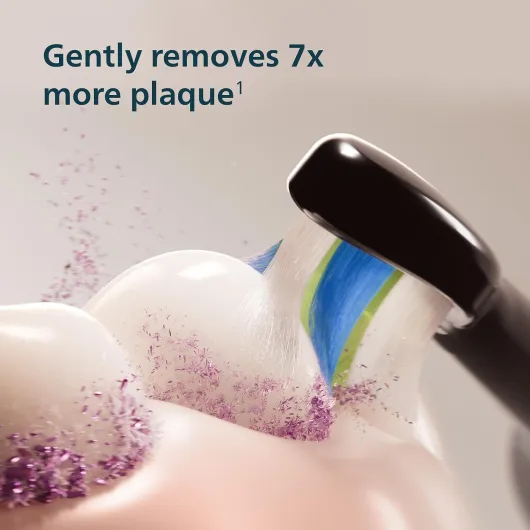
This is where the 5500 actually justifies itself. In daily use, the cleaning feels clearly better than a manual brush and a notch better than my old budget Sonicare. Philips claims up to 7x more plaque removal and up to 2x whiter teeth vs a manual brush. I can’t measure that precisely, but I can say this: after a few days, my teeth felt smoother and stayed that way longer. You know that “just left the dentist” smoothness? It’s not that level, but it’s closer than my old brush ever got.
The two modes are simple: Clean and White. Clean is what I use 90% of the time. It’s a standard 2-minute cycle with the QuadPacer and it handles daily plaque pretty well. White mode is slightly more intense and seems to focus more on surface stains. I’ve mainly used it at night. After about two weeks, I did notice some of the coffee and tea staining on my front teeth looked a bit lighter. We’re not talking professional whitening results, but for a toothbrush, the difference is visible enough that I didn’t imagine it.
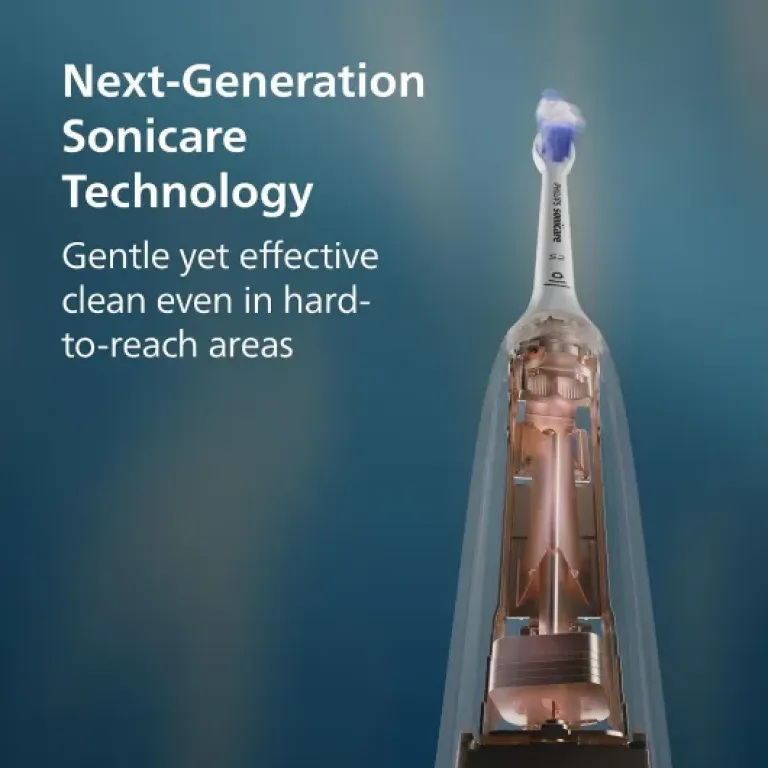
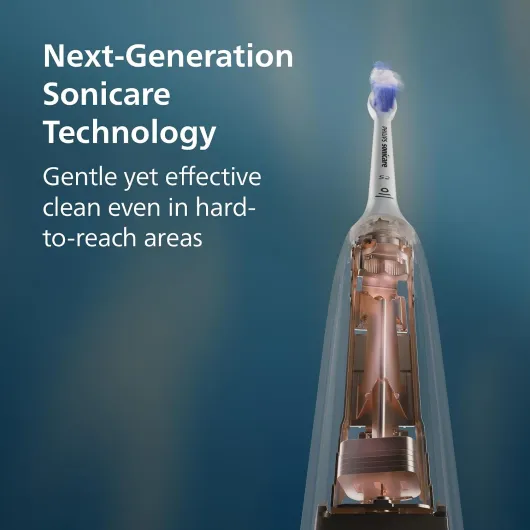
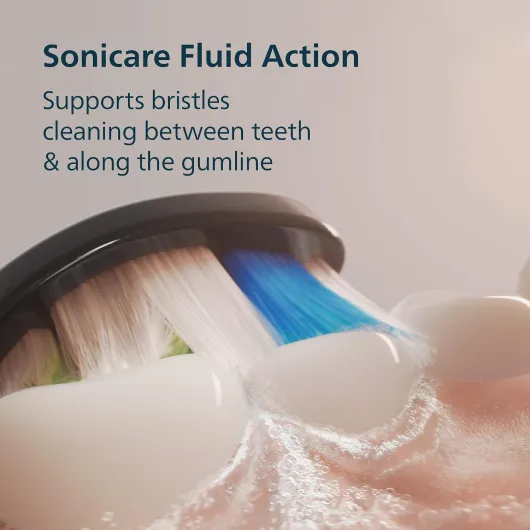
The 62,000 movements per minute marketing number is whatever, but in practice, it means there’s a strong but controlled vibration that pushes fluid and toothpaste between teeth. I notice less gunk stuck in tight gaps compared to my rotary brush, even on days when I skip flossing (yes, I know, I shouldn’t). For me, that’s the main benefit of sonic vs rotary: it cleans slightly beyond where the bristles physically touch.
In short, it gets the core job done well. My mouth feels clean, breath feels fresher for longer, and my teeth feel less rough at the end of the day. It’s not magic, and you still need floss or interdental brushes if you’ve got tight spaces or gum issues, but as a daily cleaning tool, it’s clearly a step up from cheaper electrics and definitely from manual brushes.
Pros
- Cleans very well with noticeable smoothness and reduced surface staining compared to basic brushes
- Strong battery life (around 2–3 weeks per charge with normal use)
- Pressure alert and QuadPacer timer genuinely help with better brushing habits
Cons
- High official retail price for a brush with only two modes and no smart features
- Replacement heads are expensive and less easy to find than some competitors
Conclusion
Editor's rating
After using the Philips Sonicare 5500 daily, my takeaway is simple: it’s a solid, no-nonsense electric toothbrush that does the main job very well. Cleaning performance is strong, my teeth feel smoother, and surface stains from coffee and tea do seem reduced after a couple of weeks. The pressure alert is actually useful if you tend to scrub too hard, and the QuadPacer timer makes it easy to hit the proper 2-minute routine without thinking about it. Battery life is another strong point – you’re looking at roughly 2–3 weeks per charge with normal use, which makes it easy to live with.
On the flip side, it’s not a bargain. The official list price feels high for what you get: two modes, one head, a basic charger, and that’s it. The long-term cost of replacement heads is also something to keep in mind, especially if you’re used to grabbing Oral-B heads cheaply in supermarkets. So who is it for? It’s good for people who want a reliable, simple sonic brush with strong cleaning and good battery, and who don’t care about apps and extra gimmicks. Who should skip it? If you’re very price-sensitive, happy with a basic electric brush, or you don’t want to deal with expensive replacement heads, you might be better off with a cheaper Sonicare model or an Oral-B where heads are easier to find and often cheaper.

![Sonicare 6100 Electric Toothbrush, Sonic Toothbrush with 2 Brushing Modes and 3 Intensity Levels, Pressure Alert, EasyStart, SmarTimer, Travel Case, White, Model HX7400/02 [New Technology] [New] Sonicare 6100, White, 3 Brush Heads](https://www.electric-toothbrush-guru.com/storage/1018140/conversions/716cWACgncL._AC_SL1500_-medium.webp)
![Sonicare 5500 Electric Toothbrush, Sonic Toothbrush with 2 Modes, Pressure Alert, EasyStart, SmarTimer and BrushPacer, Navy, Model HX7113/01 [New Technology] Sonicare 5500, Navy, Travel Case](https://www.electric-toothbrush-guru.com/storage/1025316/71vNjog50vL._AC_SL1500_.jpg)