
Summary
Editor's rating
Is it worth the price once you factor in replacement heads?
Simple design, decent grip, slightly annoying button
Battery life and charging: not perfect, but fine for routine use
Comfort in the mouth and in the hand: mostly good, with a learning curve
Daily performance and noise level
What you actually get in the box
Does it actually clean better than a manual brush?
Pros
- Cleans noticeably better than a manual toothbrush, especially along the gumline and back teeth
- Built-in timer and pressure sensor help improve brushing habits without extra gadgets or apps
- Comfortable grip and widely available replacement heads with different options (sensitive, whitening, etc.)
Cons
- Replacement brush heads are relatively expensive compared to some other brands or generics
- Single button control is a bit annoying and the brush doesn’t automatically stop at 2 minutes
- Battery life is decent but not impressive, and the charging base isn’t very travel-friendly

Specifications
View full product page →| Brand | Oral-B |
A basic electric toothbrush that actually feels like an upgrade
I’ve been using the Oral-B Pro 1000 (the pink one) for a few weeks now, after years of switching between manual brushes and cheaper battery-powered ones. I didn’t go into this expecting some life-changing gadget, I just wanted something that cleaned better without costing as much as the high-end Bluetooth models. So this is very much a real-world take: bathroom counter, half-asleep in the morning, nothing fancy.
The first thing I noticed after the switch was the difference in how clean my teeth felt right after brushing. With a manual brush, I always had that slightly rough feeling on the back teeth and near the gumline, especially if I was in a rush. With this one, that roughness mostly disappeared. It’s not magic, it’s just that the head actually gets into spots I was clearly skipping before, especially around the molars.
I also picked this model because it’s kind of the middle ground in Oral-B’s lineup: not the super cheap disposable-feeling ones, and not the overkill ones with an app and 12 modes. It has a timer, a pressure sensor, and a couple of modes. That’s it. For daily use, that’s honestly enough for me. I don’t need my toothbrush to send notifications to my phone.
If you’re wondering whether it’s worth going from a manual brush to this specific Pro 1000, that’s basically what this review is about. I’ll go through what I liked, what annoyed me, and whether I think it’s worth the price, especially once you factor in the ongoing cost of replacement heads.
Is it worth the price once you factor in replacement heads?
On value, this is where things get a bit more mixed. The handle itself usually sits in the mid-range price bracket. It’s not dirt cheap, but it’s not one of those high-end models either. For what it offers—good cleaning, pressure sensor, timer, and compatibility with a bunch of Oral-B heads—I’d say the base price is pretty fair. You feel like you’re paying for a solid tool, not just a plastic stick.
The part that adds up over time is the replacement heads. Oral-B heads are not the cheapest on the market, and you’re supposed to replace them roughly every three months. If you buy the official ones (CrossAction, Sensitive, etc.), the cost per head can sting a bit, especially if multiple people in the house use Oral-B brushes. You can find multipacks that bring the price down, but it’s still more than generic brands.
Compared to some other brands or off-brand electric brushes, you’re definitely paying a bit for the Oral-B name and the ecosystem. The upside is that heads are easy to find pretty much anywhere: supermarkets, pharmacies, online, etc. So you’re not stuck hunting for obscure refills. The downside is you know you could be spending less if you didn’t care about the brand or the specific round-head system.
Overall, I’d rate the value as good but not outstanding. If you’re upgrading from a manual brush and want something reliable from a big brand, the Pro 1000 makes sense and doesn’t feel like a waste of money. If you’re very price-sensitive and hate ongoing costs, the brush head prices might annoy you over time, and a cheaper system or a different brand might fit you better. It comes down to whether you’re okay paying a bit extra for a known, widely used system that actually cleans well.
Simple design, decent grip, slightly annoying button
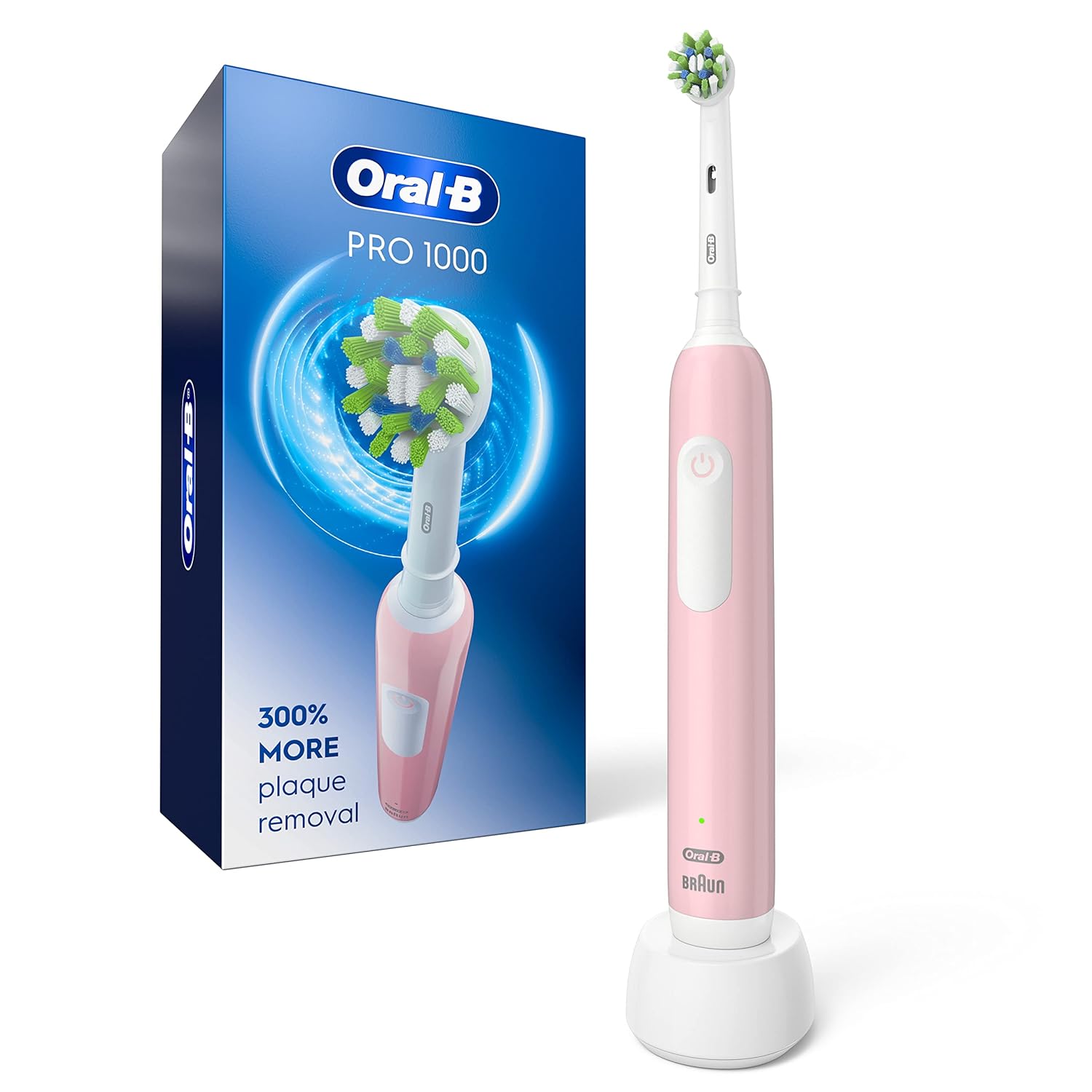
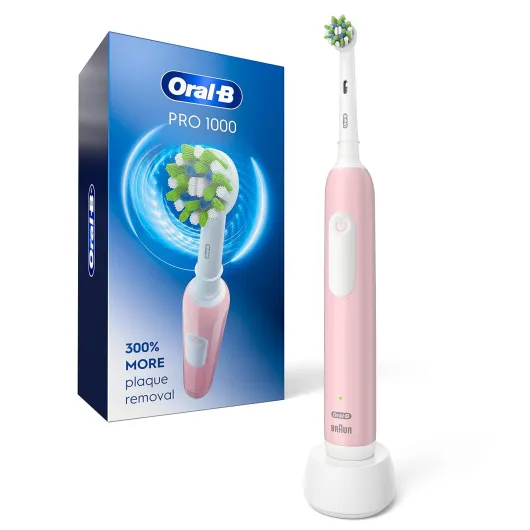
Design-wise, the Oral-B Pro 1000 is pretty basic, but in a good way. The handle is mostly white with a pink rubberized grip in the center. That pink part is not just for looks; it actually helps when your hands are wet, so the brush doesn’t feel like it’s going to slip out and land in the sink. The shape is slightly chunky but not huge, so it’s easy enough to hold whether you’ve got small or bigger hands.
The brush head is the classic Oral-B round style. Compared to rectangular manual brushes, this round head does make it easier to get around each tooth, especially near the back and along the gumline. I found it particularly useful for my lower molars, where I usually cut corners when I’m in a hurry. The head feels firm but not brutal, and the size is small enough to move around without feeling like you’re stretching your mouth open too wide.
Now, the weak point for me is the button. There’s only one button that does everything: on, off, and mode changes. If you press it once, you get the standard clean, press again for sensitive, press a third time for another mode, and then again to turn it off. In practice, if you just want to stop the brush, you sometimes end up cycling through modes by accident. If you have longer nails, this is even more annoying, because the button is a bit small and quite flat. It’s not a deal-breaker, but it’s one of those low-level irritations you notice twice a day.
On the plus side, the LED charge indicator is clear enough. When it’s running low, the light lets you know, and when it’s charging it blinks. No screen, no extra lights, just that. So in terms of design, I’d say it’s functional, easy to clean, and not too bulky, but with a slightly awkward button layout that could have been thought out better.
Battery life and charging: not perfect, but fine for routine use
The battery on the Oral-B Pro 1000 is decent, but not mind-blowing. For me, brushing twice a day for two minutes, I got roughly a week to ten days before the charge indicator started complaining. Some people stretch it a bit longer, but I wouldn’t plan on more than that if you don’t want to get caught mid-brush with a dying handle. So it’s fine for home use, and short trips if you charge it beforehand, but for longer travel you either bring the charger or accept that it might die on you.
Charging is simple: you drop the handle onto the little induction base, and the light blinks while it charges. The initial full charge took overnight, which matches what other users say. This isn’t a quick-charge type of device. You kind of just plug it in, leave it overnight, and forget about it. For a bathroom gadget you use twice a day, that’s acceptable, but if you’re expecting phone-style fast charging, that’s not happening here.
The LED indicator does its job but doesn’t give you detailed info. It’s basically: charging, charged, or low. There’s no percentage or anything. The upside is that the brush doesn’t suddenly die from 100 to 0; you usually get some warning with weaker performance and the light. I got into the habit of putting it on the charger once a week, which kept things simple and avoided surprises.
One small downside is that the charging base uses a standard bathroom outlet plug and is not super compact. It’s fine on a counter, but if you have a tiny sink area or travel a lot, it’s not the most portable setup. Still, for regular home use, the battery and charger are good enough, just not impressive. They get the job done without adding much convenience beyond the basics.
Comfort in the mouth and in the hand: mostly good, with a learning curve
In terms of comfort, there are two sides: how it feels in your hand and how it feels in your mouth. In the hand, it’s pretty comfortable. The rubber grip does its job, and the weight is balanced enough that you don’t feel like you’re doing a workout just to clean your teeth. After a full two-minute cycle, my hand never felt tired or cramped. The handle doesn’t vibrate excessively either, so it doesn’t give you that numb-fingers feeling some cheap electric brushes do.
In the mouth, the first couple of uses felt a bit intense. If you’re switching from a manual brush, the oscillating and pulsating motion is going to feel strong at first. The standard mode has a bit of a buzz to it, and I definitely felt my gums reacting during the first few days, especially near sensitive areas. After about a week, it felt normal, and I actually started to like that “thorough” feeling. If your gums are already irritated or you know you’re sensitive, the sensitive mode is useful. It dials things down just enough so you’re not wincing.
The pressure sensor is a nice safety net for comfort. I’m used to brushing too hard with manual brushes, and my dentist has commented on that before. With this handle, when you push too hard, it stops the pulsations, and you can feel the difference immediately. There’s no loud alarm or anything, but you notice the change in vibration and tend to back off. Over a couple of weeks, it actually helped me relax my grip and let the brush do the work instead of scrubbing like crazy.
Inside the mouth, the round head is easy to maneuver, but if you’re not used to this shape, it takes a few days to figure out how to move it tooth by tooth instead of brushing like a manual. Once you get that rhythm, the comfort is decent. It’s not super soft, but it’s not harsh either, especially if you use the right mode. Overall, I’d say comfort is pretty solid for daily use, with a small adjustment period if you’re new to electric brushes or have sensitive gums.
Daily performance and noise level
On daily performance, the Pro 1000 is pretty reliable. It starts up quickly, doesn’t bog down, and the brushing strength stays consistent during the session. It doesn’t feel like it weakens halfway through a two-minute cycle, even when the battery is getting low. The vibration pattern for the 30-second intervals is easy to notice without being jarring, so you don’t have to stare at a clock or count in your head.
Noise-wise, it’s not silent, but it’s not a power drill either. It has that typical electric toothbrush buzz. If someone is sleeping right next to the bathroom, they’ll probably hear it, but it’s not outrageous. Compared to some sonic brushes, it might sound a bit more mechanical because of the oscillating head, but you get used to it quickly. I never felt like I needed to turn up the tap or fan to cover the sound.
Switching modes is where performance gets slightly less smooth. Since everything runs through that one button, if you want to go from regular clean to sensitive or polishing, you have to cycle through while the brush is on. You can’t see the modes on a screen, so you learn them by feel and sound. After a while, you know what each one feels like, but the first days are trial and error. It still works, but it’s not the most user-friendly system.
In terms of reliability, I didn’t notice any weird behavior like random shut-offs or inconsistent vibrations. The head stays locked in firmly, doesn’t wobble, and is easy to pop off when you want to change it. Rinsing the handle under water is straightforward, and toothpaste residue doesn’t build up too badly around the head connector if you give it a quick rinse after each use. Overall, daily performance is solid: it does the same thing every time, with no surprises, which is what you want in something you’re putting in your mouth twice a day.
What you actually get in the box
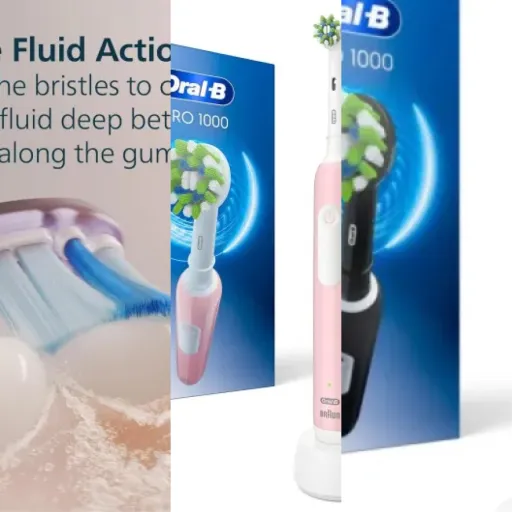
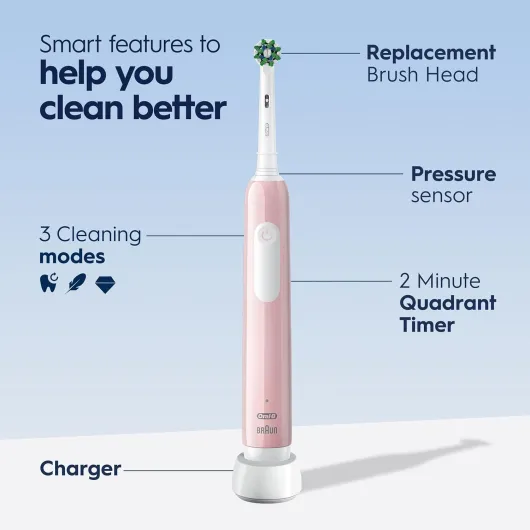
Out of the box, the Oral-B Pro 1000 is pretty straightforward. You get the handle, one CrossAction brush head, and the charging base. No travel case, no extra heads, no pouch, nothing fancy. If you’re expecting a full kit with multiple heads and accessories, this isn’t that. It’s more like: here’s the handle, here’s one head, go brush your teeth. On one hand it feels a bit bare, on the other it keeps the package simple.
The handle itself feels like a mid-range product. It doesn’t feel cheap or hollow, but it also doesn’t feel super premium. It has a bit of weight to it, which I actually like because it sits better in the hand and doesn’t feel like a toy. The pink color is more of a soft, slightly glossy pink, not neon. If you share a bathroom with other people who also have Oral-B handles, the color does make it easier to know which one is yours at a glance.
In terms of features, Oral-B advertises 3 modes, a pressure sensor, and a timer. In practice, that means one main button that cycles between modes, and the handle does a little pause every 30 seconds to tell you to switch areas of your mouth. After two minutes, it does a slightly different vibration pattern so you know the dentist-recommended time is up, but the brush doesn’t automatically shut off. You have to manually stop it, which is a bit old-school compared to some other models.
Overall, the presentation is very much "no nonsense". You’re not buying an ecosystem, you’re buying a base handle that works with a ton of Oral-B heads you can get later: sensitive, whitening, deep clean, etc. If you’re someone who likes to tinker and swap heads, that’s a plus. If you just want something that works out of the box without thinking too much, this still fits, but just know you’re only getting one head to start with.
Does it actually clean better than a manual brush?
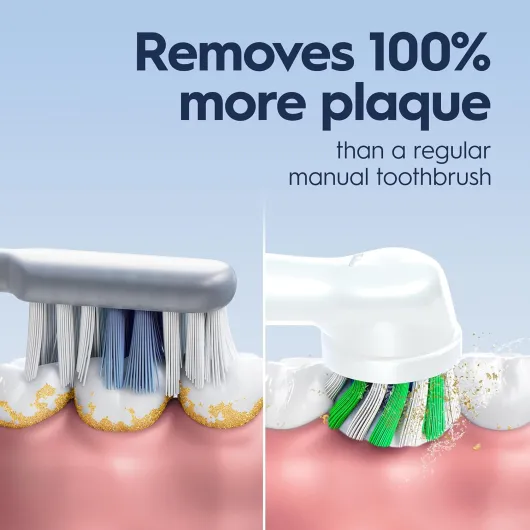
This is the main point: does the Oral-B Pro 1000 actually clean better than a regular toothbrush? For me, yes. After the first few brushes, my teeth felt noticeably smoother, especially along the gumline and at the back. That "fuzzy" feeling that builds up during the day was reduced, and in the morning my teeth still felt cleaner than they usually did with a manual brush. It’s not like going to the dentist for a full cleaning, but for daily use, it does a better job than I was doing by hand.
The 3D movement (oscillating, rotating, pulsating) sounds like marketing talk, but in practice, you do feel it breaking up the gunk better, especially between teeth. I noticed less plaque buildup between my lower front teeth, which is usually where things get rough by the end of the day. You still need floss, obviously, but this brush does help reduce the amount of stuff stuck around the edges. The 30-second quadrant timer also forces you to not rush through one side and ignore the other, which I used to do without thinking.
The pressure sensor plays into effectiveness too. Before, I thought brushing harder meant cleaner teeth, but my dentist told me otherwise. With this handle, when I overdo it, the pulsations stop, and it’s an instant reminder to lighten up. Over time, that not only protects your gums, but it also keeps the bristles from bending out of shape too quickly, which helps maintain cleaning performance between head changes.
After a couple of weeks, I could see a small difference in how my gums looked—slightly less red in certain spots. I’m not claiming it fixes everything, but paired with decent brushing habits, it clearly gets the job done better than a basic manual brush. If you’re sloppy with a manual brush, this model covers up some of that laziness by guiding you with the timer and doing more of the mechanical work for you.
Pros
- Cleans noticeably better than a manual toothbrush, especially along the gumline and back teeth
- Built-in timer and pressure sensor help improve brushing habits without extra gadgets or apps
- Comfortable grip and widely available replacement heads with different options (sensitive, whitening, etc.)
Cons
- Replacement brush heads are relatively expensive compared to some other brands or generics
- Single button control is a bit annoying and the brush doesn’t automatically stop at 2 minutes
- Battery life is decent but not impressive, and the charging base isn’t very travel-friendly
Conclusion
Editor's rating
The Oral-B Pro 1000 in pink is a straightforward electric toothbrush that does what it’s supposed to do: it cleans better than a manual brush without burying you in features you’ll never use. The cleaning performance is the main reason to buy it. Teeth feel smoother, plaque buildup is reduced, and the combination of the 30-second timer and pressure sensor nudges you into better brushing habits without making it complicated. Comfort is decent once you get used to the feeling of an electric brush, and the round head does a solid job around the gumline and back teeth.
It’s not perfect. The single button system is a bit clumsy, the brush doesn’t turn off automatically at two minutes, the battery is okay but not impressive, and the ongoing cost of replacement heads is on the higher side. You’re definitely paying partly for the Oral-B name and the ecosystem. If you just want the absolute cheapest way to go electric, this isn’t it. But if you want a reliable, no-frills handle from a known brand that you can keep for years and just swap heads on, it fits that role well.
I’d recommend this to people who are coming from manual brushes or very basic battery brushes and want a simple upgrade that actually improves their daily cleaning. It’s also a good pick if your dentist has told you that you brush too hard, thanks to that pressure sensor. If you already own a higher-end electric brush or you’re extremely price-sensitive about refills, you might want to look at other options. For most everyday users, though, this is a pretty solid middle-ground choice that gets the job done without overcomplicating your bathroom routine.
![Sonicare 5500 Electric Toothbrush, Sonic Toothbrush with 2 Modes, Pressure Alert, EasyStart, SmarTimer and BrushPacer, Navy, Model HX7113/01 [New Technology] Sonicare 5500, Navy, Travel Case](https://www.electric-toothbrush-guru.com/storage/1025316/conversions/71vNjog50vL._AC_SL1500_-medium.webp)