
Summary
Editor's rating
Value for money: strong performance, painful price
Design: looks fancy, with a few practical quirks
Battery life and charging in real life
Comfort in the mouth and in the hand
Durability and long-term feel (so far)
Smart features, app, and daily use performance
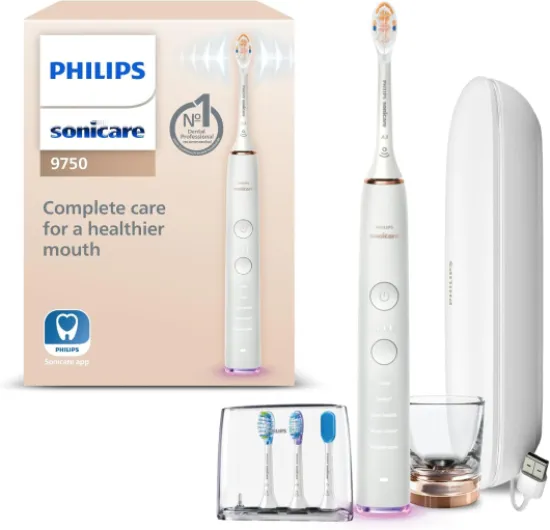
What you actually get in the box
Effectiveness: does it actually clean better?
Pros
- Cleans very effectively with noticeably smoother teeth and healthier-feeling gums
- Strong battery life (around 2–3 weeks per charge) and useful travel case with USB charging
- Pressure sensor and multiple modes/intensity levels help protect gums and customize comfort
Cons
- Very expensive upfront and replacement brush heads are also pricey
- Smart app is more of a novelty after the first few days than a daily necessity
- Charging glass is bulky and fragile compared to a simple charging stand

Specifications
View full product page →| Brand | Philips Sonicare |
A £200+ toothbrush… seriously?
I picked up the Philips Sonicare DiamondClean Smart 9750 because my old basic Sonicare finally died and my dentist kept nagging me about plaque around the gum line. I’ll be honest: the price hurt. This is not a cheap gadget, it’s in the “I better notice a difference” category. I’ve been using it twice a day for a bit over two weeks, swapping between the included heads to see if all the marketing about modes and smart features actually changes anything in real life.
From day one, what hit me most was the power and vibration frequency compared to my older Sonicare. On the standard Clean mode it feels more intense but not harsh, and you really notice it along the gum line and between teeth. After the first use, my teeth had that dentist-polish feel you normally get after a cleaning. That was the main thing that made me think, “okay, maybe this stupid price isn’t total madness.”
I also tried the app, the pressure sensor, and the brush head recognition. Some of it is genuinely useful, some of it feels like features made for the product page rather than for actual humans. The app is cool for the first few days, but I’ll explain later why I basically stopped opening it. The pressure sensor, on the other hand, helped me notice I’d been brushing like I was sanding wood.
Overall, my first impression is: it cleans very well, the handle looks premium, and the smart stuff is a mixed bag. If you’re already used to electric toothbrushes, this is a noticeable step up in performance, but it’s also a noticeable punch to the wallet. The rest of this review is just me breaking down where I think it earns the price and where Philips is just flexing.
Value for money: strong performance, painful price
Let’s talk about the awkward part: the price. The DiamondClean Smart 9750 sits at the top end of the electric toothbrush market. You’re paying for the brand, the design, the extra modes, the app, and the whole “smart” positioning. In terms of pure cleaning performance, yes, it’s one of the better brushes I’ve used. My teeth feel cleaner, my gums seem healthier, and I can see small cosmetic improvements in staining. So from a results point of view, it delivers.
But if I strip away the nice glass, the travel case, and the app, a cheaper Sonicare model with fewer modes would probably give 80–90% of the same cleaning effect. The pressure sensor is the only smart feature I’d really miss. The rest is convenience and aesthetics. Also, replacement heads are pricey, especially the premium ones included here. Over a couple of years, the cost of heads plus the initial price adds up to a small fortune just to keep your mouth clean.
If you’re the kind of person who already spends money on dental care, whitening, and gadgets, this will feel like a justifiable upgrade and you’ll probably appreciate the full kit. If you just want a solid electric toothbrush that cleans better than a manual, you can save quite a bit by dropping to a mid-range Sonicare without the smart app and fancy glass. The cleaning difference won’t be night and day for most people, but the price difference will.
So in terms of value, I’d call it good but not cheap. It’s not a rip-off because it actually performs well and feels well built, but it’s definitely at the luxury end of oral care. If you buy it, do it for the performance and long-term gum health, not just because the rose gold looks nice on the sink.
Design: looks fancy, with a few practical quirks
The Rose Gold version is clearly made to look “premium bathroom Instagram ready”. The finish is matte, not glossy, so it doesn’t scream plastic even though it is plastic. The handle is slim enough to hold comfortably, and the single button plus light ring layout keeps it simple. You don’t have a screen or a crazy amount of buttons, which I actually prefer. The light ring around the bottom is the pressure warning, and it’s bright enough that you notice it even half-asleep in the morning.
The charging glass is the flashy part. You drop the handle into the glass and it charges inductively through the base. It looks cool and it does the job, but in practice it takes more space on the sink than a basic charging stand. Also, the glass is glass: drop it on a tiled floor and you’ve got a mess. It’s nice if you like the look, but functionally, a simple stand would do the same thing. I ended up using the glass but I can see some people putting it back in the box after a while.
The travel case is actually one of the more useful design bits. It feels sturdy, closes properly, and has a USB charging option so you can plug it into a laptop or power bank. Inside, there’s room for the handle and two heads. It’s not super compact, but it’s fine for a carry-on. For someone who travels a lot, this is more useful than the fancy glass. For someone who never leaves home, it will just live in a drawer.
Overall, the design is clean and mostly practical. It looks like a premium gadget, but it’s not overcomplicated. My only real complaint is that the glossy rose gold accents can show water marks and toothpaste a bit, so you do end up wiping it more often if you care about how it looks. If you don’t care and just want it to clean, the design won’t get in your way, aside from the slightly bulky charging setup.
Battery life and charging in real life
Battery-wise, Philips claims a long runtime, and in practice it’s pretty solid. With 2–3 brushes per day on mostly standard Clean and Gum Health modes, I got just under three weeks before the battery indicator started flashing low. That’s with Bluetooth occasionally on for the app in the first week, then mostly off. For daily use, charging once every two to three weeks is more than enough, and you don’t really have to think about it.
The charging glass and base work fine: you just drop the handle in and it starts charging automatically. From almost empty to full took around 12–14 hours in my case, but I didn’t time it to the minute. This is more of an overnight thing than a quick top-up. If you forget to charge and it dies, you’re not getting a full charge in 15 minutes. On the plus side, the battery indicator gives you enough warning before it fully dies, so you’d have to really ignore it to get caught out.
The travel case with USB charging is handy if you’re going away for longer than two weeks or just like the security. Honestly, with the battery life being that good, for a one-week trip you can probably skip bringing the charger entirely. For longer trips, you can just plug the case into any USB port. That’s more convenient than carrying the glass and base, which are bulky and more suited to staying at home.
Overall, I’d rate the battery performance as very reliable. It’s not something you’ll be constantly managing. If you’re coming from a cheaper electric brush that needs charging every few days, this will feel like an upgrade. The only thing I’d improve is faster charging, but for a toothbrush that’s more of a nice-to-have than a real issue.
Comfort in the mouth and in the hand
On the comfort side, the handle is light and nicely balanced. Even during the full 2–3 minute cycles, it doesn’t feel heavy or awkward. The vibration is strong but the handle doesn’t buzz in a way that numbs your fingers, which I’ve had with some cheaper brushes. The matte surface gives enough grip even with wet hands, though I wouldn’t mind a small rubberized area for extra grip, especially if you’re the type to brush in the shower.
In the mouth, the bristle feel is on the softer side, but the sonic vibration makes it feel quite intense on higher settings. The first few days, my gums were a bit sensitive after using the C3 Plaque Control head on medium intensity. After about five days, that went away and my gums actually looked less red around the edges. If you have very sensitive gums, I’d start on the lowest intensity and probably stick to the A3 head at first. The built-in pressure sensor does help you avoid grinding the brush into your gums, which is a bonus for comfort and long-term gum health.
The brushing experience is noisy but not crazy loud. It’s that typical Sonicare high-pitched buzz, definitely less loud than some oscillating-rotating brushes from other brands. If someone is sleeping in the next room with the door closed, they probably won’t hear it. In the mouth, it’s more the vibration feeling than the sound that stands out. You get used to it after a couple of days, especially if you’ve already used a sonic brush before.
Overall, I’d say comfort is pretty solid. It’s not so gentle that you forget it’s there, but it’s not painful or harsh either once you’ve dialed in your settings. The combination of softer bristles, pressure sensor, and intensity levels means you can tune it to what your gums can handle. Just don’t jump straight into maximum intensity on day one unless you like suffering.
Durability and long-term feel (so far)
I’ve only had it for a few weeks, so I can’t pretend to know how it will hold up over years, but there are a few signs. The handle feels solid, no creaks when you twist it, and the button has a firm click. Nothing about it feels flimsy. It’s water-resistant enough for normal bathroom use; I’ve rinsed it under the tap every day and there’s no sign of water getting into the seams or under the button.
The brush heads clip on firmly and don’t wobble during use. After two weeks of twice-daily brushing, the bristles on both the A3 and C3 heads still look fine – no crazy splaying or flattening. Philips typically recommends changing heads every three months, and based on how these look now, that seems realistic. Just remember that these premium heads are more expensive than generic ones, so long-term durability of the heads matters for your wallet too.
The charging glass and base are the bits I’m slightly less confident about in terms of durability, mainly because the glass is, well, glass. If you’re clumsy or have a small bathroom with hard floors, I’d be careful. The base itself feels sturdy enough and the contacts haven’t corroded or discoloured so far. The travel case hinge and latch also feel decent; they don’t feel like they’ll snap after a few trips, but time will tell.
Overall, the build quality gives the impression that it should last several years if you don’t drop it or abuse it. I’ve had older Sonicare handles last 4–5 years before the battery started fading, so if this one follows the same pattern, the high price spreads out a bit over time. Still, at this price, I’d expect it to survive daily use without weird failures, and so far it seems up to the task.
Smart features, app, and daily use performance
On the performance side, the core brushing is solid, but the “smart” extras are a bit mixed. The pressure sensor is the most useful one. The light ring flashes when you push too hard, and after a couple of days I realized I was pressing way more than needed, especially on my front teeth. Once I adjusted, the light barely came on anymore. That’s a simple feature, but it actually changed how I brush.
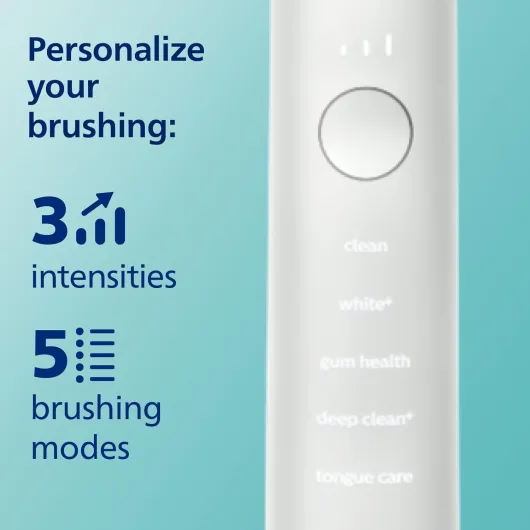
The brush head detection is also decent. When you clip on the A3 versus the C3 head, the handle automatically picks a matching mode. It’s not life-changing, but it saves a couple of button presses and makes it easier for less techy people to just use the brush without thinking too much. You can still cycle through the 5 modes and 3 intensities with the single button, but it’s easy to accidentally skip the mode you want until you get used to the sequence.
The Philips Sonicare app is where things get a bit “nice idea, average execution.” On day one, I used it properly: it tracks coverage, shows you which areas you’re missing, and gives feedback on pressure and time. After about four days, I stopped bothering most of the time. Holding your phone, watching a live map of your mouth while brushing, is not something I want to do twice a day. The app is useful if your dentist has told you that you’re missing big zones, or if you’re trying to build a habit, but for everyday use it feels like overkill.
Overall, daily performance is reliable and consistent. The brush starts, runs the full cycle with quad-pacer beeps (so you know when to switch quadrant), and shuts off. No weird glitches, no random mode changes. The smart stuff is there, but I’d say the pressure sensor is the only one that really matters long term. The rest is nice to have for a week, then you either ignore it or use it occasionally out of curiosity.
What you actually get in the box
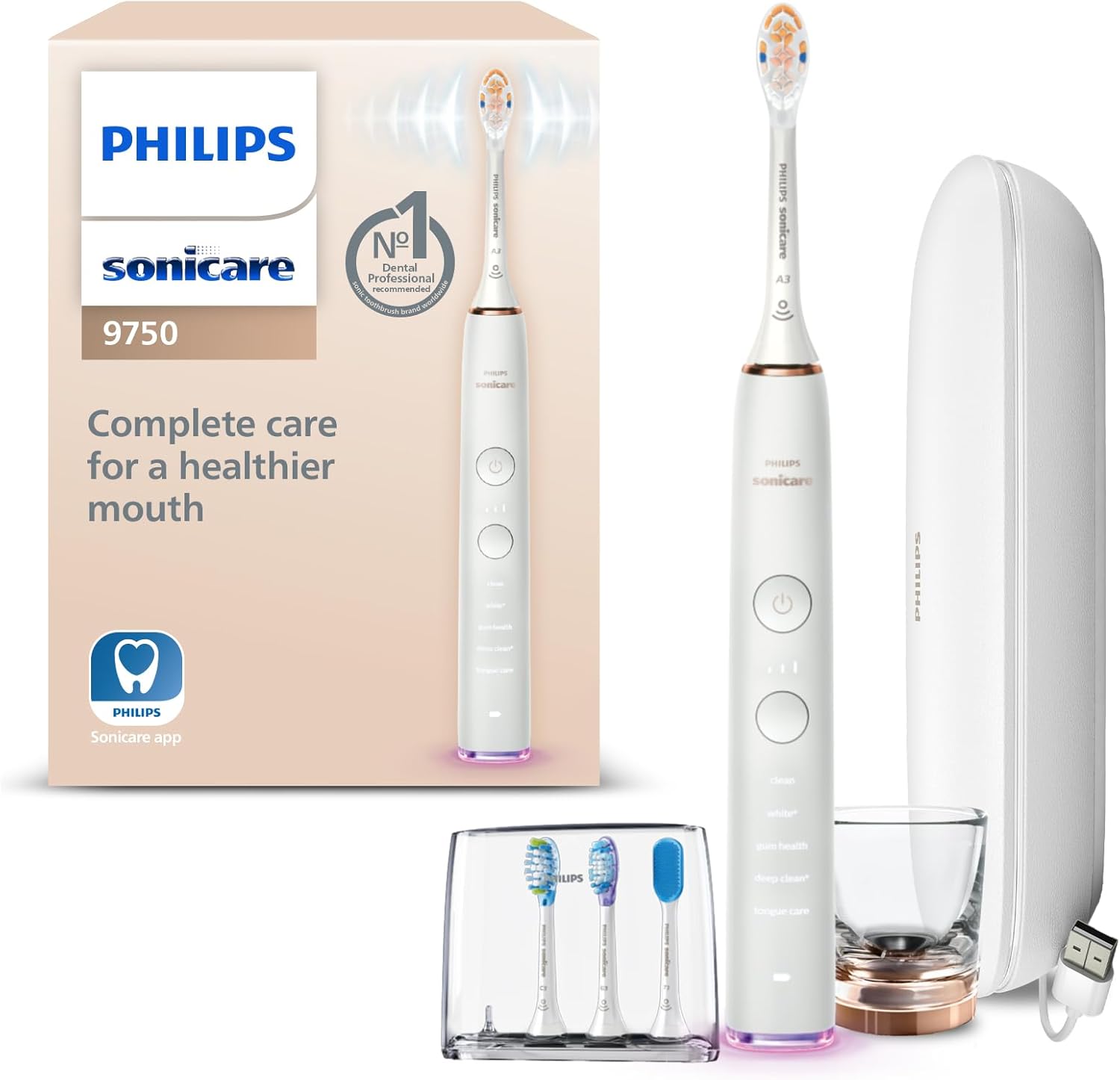
Out of the box, the DiamondClean Smart 9750 feels like a complete kit rather than “toothbrush plus random extras”. In my package I got: the Rose Gold handle, an A3 Premium All-in-One brush head, a C3 Premium Plaque Control brush head, the charging glass, a travel case with built-in USB charging, and the charging base. No batteries to buy, it’s fully rechargeable. It’s clearly aimed at people who travel and like their gadgets to look nice sitting on the bathroom counter.
The two brush heads are actually quite different. The A3 Premium All-in-One is a bit fuller and feels like an all-rounder: plaque, gums, and light stain removal. The C3 Plaque Control head is narrower and feels more aggressive on plaque, especially along the gum line and between teeth. If you already have sensitive gums, the C3 on high intensity might be a bit much at first. Both heads are on the softer side in terms of bristle firmness, so it doesn’t feel like a wire brush in your mouth.
The toothbrush supports 5 brushing modes and 3 intensity levels. The modes are things like Clean, White+, Gum Health, Deep Clean+, and Tongue Care. The handle automatically detects the brush head and switches to what it thinks is the right mode, which is actually convenient. For example, pop on the plaque head and it kicks into a more intensive clean mode. You can still override it if you want, but most of the time I just left it as is and adjusted intensity.
In terms of first contact, the set feels complete and high-end, but also slightly overbuilt. If you’re the type who wants one mode and one head, half of this won’t matter to you. If you like having specific heads and modes for plaque, whitening, and gums, then this kit gives you most of what you need right away without buying extra heads on day one. Just know that replacement heads are not cheap, so long-term cost is something to factor in.
Effectiveness: does it actually clean better?
This is where the toothbrush earns its keep. Compared to a manual brush and even compared to my older basic Sonicare, the DiamondClean Smart 9750 cleans very thoroughly. After one week of using it twice a day, my teeth felt consistently smooth, even at the back molars where plaque usually hangs around. Running my tongue along the inside surfaces, they felt polished, not just “less dirty.” That’s the closest thing to an objective feeling I can describe.
I mainly used the standard Clean mode in the morning and either Deep Clean+ or Gum Health in the evening. The Gum Health mode spends more time near the gum line with a slightly different vibration pattern, and I did notice less bleeding when flossing after about 7–10 days. Before, I’d get a bit of blood in a couple of spots; after using this regularly, that basically stopped unless I really jabbed the floss. That lines up with the claim of better gum health, at least in my case.
On staining, I drink coffee and tea daily. I’m not talking Hollywood white teeth here, but after two weeks, the front teeth looked a bit brighter and the small yellowish edges near the gums were less noticeable. Using the White+ mode a few times a week with the A3 head seemed to help with that. It’s not some instant whitening miracle, but you can see a small difference if you actually pay attention.
Where it really stands out is in the hard-to-reach areas. The combination of the sonic motion and the slim head means it got behind my lower front teeth and around my wisdom teeth more effectively than my older brush. When I went back to a manual brush for one day (just to compare), it felt like going backwards. So yes, in terms of raw effectiveness, it does the job very well. Whether that’s worth the price is another question, but cleaning performance itself is not the weak point here.
Pros
- Cleans very effectively with noticeably smoother teeth and healthier-feeling gums
- Strong battery life (around 2–3 weeks per charge) and useful travel case with USB charging
- Pressure sensor and multiple modes/intensity levels help protect gums and customize comfort
Cons
- Very expensive upfront and replacement brush heads are also pricey
- Smart app is more of a novelty after the first few days than a daily necessity
- Charging glass is bulky and fragile compared to a simple charging stand
Conclusion
Editor's rating
After using the Philips Sonicare DiamondClean Smart 9750 twice a day for a few weeks, my overall take is pretty simple: it cleans very well, but you pay for it. My teeth feel smoother, my gums bleed less when flossing, and even some light staining from coffee looks reduced. On the core job – removing plaque and keeping gums in decent shape – it does exactly what you’d hope from a high-end brush.
The extras are a mixed bag. The pressure sensor is genuinely useful, the auto mode selection by head is convenient, and the battery life is excellent. The app is fun for a few days but not something I see most people using long term. Design-wise, it looks good on the sink and the travel case is practical, but the fancy charging glass is more about style than function. Durability and build quality seem solid so far, in line with other Sonicare products I’ve used.
Who is this for? People who are serious about oral care, already like Sonicare brushes, and don’t mind spending a chunk of money for top-tier performance and a nice-looking kit. Who should skip it? Anyone on a tighter budget, or people who just want a simple electric toothbrush without apps and extra modes. A mid-range Sonicare will still clean far better than a manual brush at a much lower cost. If you do go for the 9750, you’re paying for both strong performance and the premium experience – just don’t expect the smart features to change your life.
![Sonicare 5500 Electric Toothbrush, Sonic Toothbrush with 2 Modes, Pressure Alert, EasyStart, SmarTimer and BrushPacer, Navy, Model HX7113/01 [New Technology] Sonicare 5500, Navy, Travel Case](https://www.electric-toothbrush-guru.com/storage/1025316/conversions/71vNjog50vL._AC_SL1500_-medium.webp)