
Summary
Editor's rating
Value for money: worth paying extra?
Design and build: simple, clean, and mostly practical
Battery life and charging: low-maintenance overall
Comfort in the mouth and in the hand
Durability and maintenance after regular use
What you actually get in the box
Effectiveness: does it actually clean better?
Pros
- Strong cleaning performance with multiple useful modes and 3 intensity levels
- Effective pressure sensor that helps stop you from brushing too hard
- Long battery life with convenient USB charging travel case
Cons
- High upfront price, especially at full retail
- Replacement brush heads are relatively expensive over time

Specifications
View full product page →| Brand | Philips Sonicare |
A pricier toothbrush… but does it actually feel different?
I’ve been using electric toothbrushes for years, mostly mid-range models, and honestly, after a while they all start to feel the same. I picked up the Philips Sonicare ExpertClean 7500 because my old Sonicare was fading and my dentist kept pushing me toward something with a pressure sensor and better gum care. The price hurt a bit, so I went into this slightly annoyed and very curious if it would really feel like a step up or just more marketing.
After a couple of weeks of use, my main takeaway is this: you do feel a difference compared to cheaper or older models, especially in how smooth your teeth feel and how it handles the gumline. It’s not magic, but it’s clearly stronger and more refined than the entry-level Sonicare 4100 or a basic Oral-B I had lying around. The different modes and intensities are not just gimmicks; I actually ended up using them.
In daily use, the thing that stood out the most for me was the combination of the pressure sensor and the timed cycles. It forces you to stop rushing, and it nudges you when you start scrubbing too hard like you would with a manual brush. I tend to be heavy-handed, so that feedback is genuinely useful. The app, on the other hand, is something I tried, shrugged at, and then ignored.
Overall, this isn’t a cheap impulse buy, but if you’re already in the Sonicare ecosystem or you’re moving up from a manual brush or a very basic electric, it feels like a proper upgrade. Not perfect, a bit overpriced at full retail in my opinion, but on sale it’s a pretty solid pick if you care about gum health and want something you can keep for several years.
Value for money: worth paying extra?
Let’s talk about the part that hurts: the price. The ExpertClean 7500 sits clearly in the higher mid-range to premium zone for electric toothbrushes. It’s a lot more expensive than something like the Sonicare 4100 or a basic Oral-B, and closer to the fancy models with apps and extra modes. If you pay full retail, it feels a bit steep for what is, at the end of the day, a toothbrush. But this model often goes on sale, and that’s where it starts to make more sense.
What you’re actually paying for here is a combination of things: stronger motor, multiple modes and intensities, pressure sensor, BrushSync reminders, and the travel charging case. If you already have a drawer full of chargers and don’t care about the app, some of that might feel unnecessary. But in practice, the cleaning performance and the pressure sensor are the real value. If you’ve been told you have gum issues or you tend to brush too hard, this brush can genuinely help you build better habits.
Compared to the cheaper Sonicare 4100, this 7500 feels more powerful and more flexible. You notice the difference in vibration strength and how quickly the pressure sensor reacts. Compared to high-end Oral-B models, Sonicare’s cleaning feels a bit gentler but more thorough along the gumline, while Oral-B is better at surface polishing. So it really depends what you’re after. For me, the 7500 hits a nice middle ground where you get most of the high-end features without going into absurd luxury pricing.
Long-term, remember the ongoing cost of brush heads. Genuine Philips heads are not cheap, and if two people in the same household use Sonicare, that adds up. If you’re on a tight budget and just want to move away from a manual brush, a cheaper model will still be a big step up. But if you’re okay investing a bit more for stronger performance, better gum care, and a travel-friendly setup, the 7500 offers pretty solid value when you catch it at a discount. At full price, I’d call it good but not outstanding value; on sale, it becomes a much easier recommendation.
Design and build: simple, clean, and mostly practical
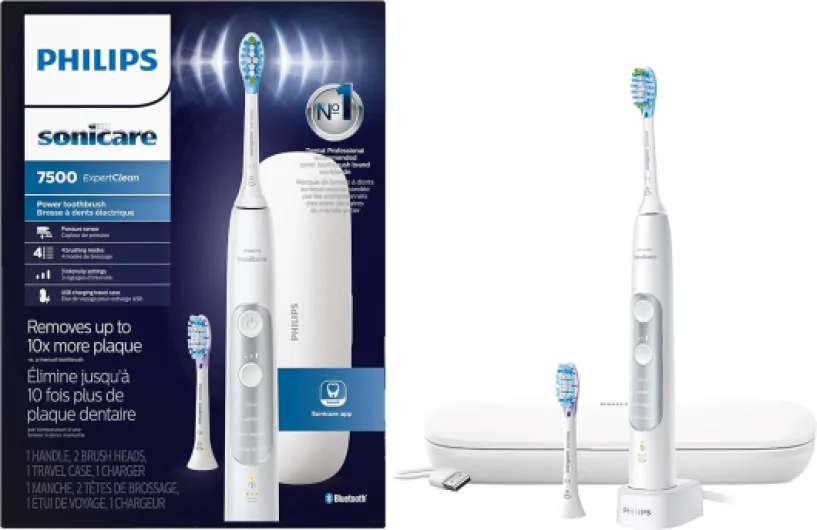
Design-wise, the ExpertClean 7500 is pretty straightforward. It’s a slim white handle with a matte-ish finish that doesn’t feel slippery, even with wet hands. I’ve had older Sonicare models with glossy plastic that got grimy fast; this one is a bit better at hiding toothpaste splatter and fingerprints. The buttons are slightly raised and easy to find without looking, even when half asleep in the morning.
The layout is simple: one main power button and one smaller button to cycle modes and intensities. There are clear icons and text for the four brushing modes, plus three small LEDs for intensity. After a couple of uses, muscle memory kicks in and you can change things quickly. Compared to some Oral-B handles with more cluttered fronts, this is cleaner. It’s not fancy, just logical. The pressure sensor doesn’t use a loud beep; instead, the vibration changes and a light on the handle cues you that you’re pushing too hard, which I actually prefer because it’s less jarring.
The travel case is decent. It’s a rigid case, white on the outside, with room for the handle and two heads. It closes with a magnet. That’s where I have a small gripe: I’d have preferred a snap or latch closure. The magnet is fine in a backpack or a suitcase pocket, but it doesn’t feel ultra-secure if it’s rattling around in a big bag. The upside is that the case doubles as a charger: you plug in the USB cable and the brush charges inside, so you don’t need to bring the main stand on trips.
In terms of day-to-day use, the design makes it easy to rinse and wipe down. There aren’t a lot of weird grooves where gunk can build up, and the click-on heads are much easier to keep clean than the old screw-on Sonicare style that tended to trap water and get moldy. So from a practical angle, the design is pretty solid: not a showpiece, but nothing that gets in the way of just brushing your teeth and moving on with your day.
Battery life and charging: low-maintenance overall
Battery life on the ExpertClean 7500 is one of the areas where it quietly does its job well. Philips claims around two weeks of use on a full charge, and in my case, brushing twice a day for 2 minutes (sometimes longer on Gum Health mode), I got around 2.5 to 3 weeks before the battery indicator dropped to the last bar. That’s on mixed modes and usually medium or high intensity. So realistically, if you’re not obsessive about keeping it at 100%, you can easily get away with charging it every couple of weeks.
The standard charging base is the typical Sonicare puck. You just drop the handle on it and it charges inductively. No fiddling with ports, and the base itself is small enough to live on a bathroom counter without taking over the whole space. The LED indicator on the handle is clear enough: you can see when it’s low and when it’s charging. There’s no fancy fast charging, but since you don’t need to charge it often, that didn’t bother me.
The nicer part, especially if you travel, is the USB charging travel case. You put the handle and up to two heads inside, plug in the USB cable, and it charges while protected in the case. For trips longer than a week, I just pack the case and a power adapter and skip the home base entirely. The case doesn’t feel super premium, but it’s practical. One thing to note: the magnet closure is fine, but I wouldn’t just toss it loose in a big suitcase with heavy stuff on top; I usually tuck it into a side pocket.
Overall, the battery experience is low-maintenance, which is exactly what you want for something you use every day. No daily charging needed, no weird battery drain, and the option to charge via USB when traveling is genuinely handy. I’d rate the battery as one of the strong points of this brush, especially if you’re coming from older models that needed more frequent top-ups.
Comfort in the mouth and in the hand
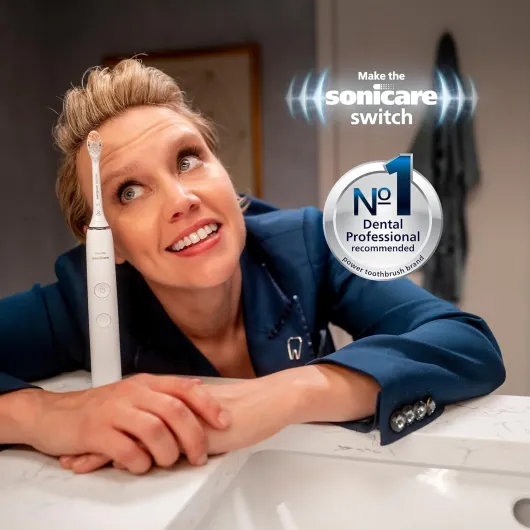
Comfort-wise, the ExpertClean 7500 hits a good balance between power and not feeling like your skull is vibrating. The first time I used it, coming from a weaker mid-range brush, I definitely noticed the stronger motor. The vibration is more intense, especially on the DeepClean+ and White+ modes, but the three intensity levels help a lot. I started on the middle intensity for a couple of days, then moved up to the highest once I got used to it.
The handle is light enough that my hand doesn’t get tired, even if I run an extra cycle on Gum Health mode around the gumline. The grip is comfortable and doesn’t feel like it will slip out of your hand, even with toothpaste foam everywhere. Compared to some chunkier Oral-B models, this one is nicer to hold for smaller hands too. No weird edges or sharp transitions around the buttons, so nothing digs into your fingers.
In the mouth, the standard head it comes with is medium firmness, and I’d call it firm but not harsh. If you have very sensitive gums, you might want to switch to a softer head (Philips has a few options). The pressure sensor is surprisingly helpful for comfort: I tend to scrub like I’m cleaning a pan, and the brush telling me to ease up actually made brushing feel less aggressive. After a few days, I naturally stopped pressing as hard, and my gums felt less sore.
Noise-wise, it’s quieter than my older Sonicare and noticeably quieter than my Oral-B Genius. You still hear the high-pitched buzz, but it’s not obnoxious. If you share a bathroom or brush early/late, it’s less likely to annoy someone in the next room. Overall, I’d say comfort is one of its strong points: powerful but manageable, with enough adjustments to make it work even if your teeth or gums are on the sensitive side.
Durability and maintenance after regular use
In terms of durability, I can’t fast-forward a few years, but I can compare the build and maintenance to older Sonicare models and to Oral-B brushes I’ve owned. The ExpertClean 7500 feels solid but not overly heavy. There’s no creaking when you squeeze the handle, and the buttons don’t feel mushy. After regular use and rinsing, the finish still looks clean, and it doesn’t stain easily from toothpaste or mouthwash splashes.
One big plus versus older Sonicare designs is how easy it is to keep the area under the brush head clean. The click-on head system doesn’t trap as much water as the old screw-on design. With my very old Sonicare, I’d regularly find gunk and sometimes mold under the head if I didn’t take it off and clean it often. With this one, I just pop the head off every few days, rinse the post and inside of the head, and it stays in good shape. It’s not magically self-cleaning, but it’s less of a hassle.
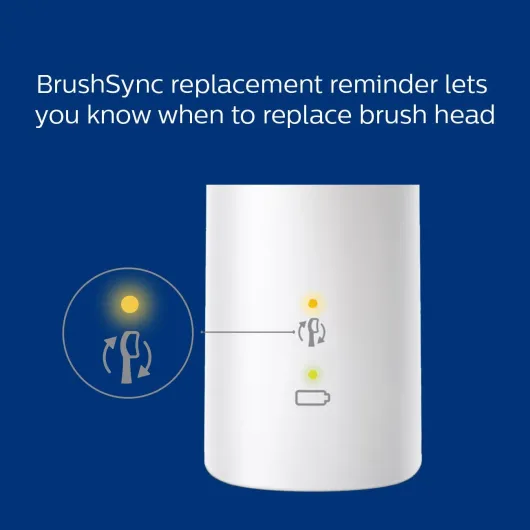
The brush heads themselves are medium firmness and feel like they’ll last about the usual 3 months with normal use. The BrushSync feature tracks usage and will light up when it’s time to change the head. You can ignore it if you want, but it’s a decent reminder if you tend to forget. Just keep in mind: official Sonicare heads are not cheap, so factor that into the long-term cost. You can find compatible third-party heads, but quality varies, and you lose the BrushSync function.
As for water resistance, I’ve rinsed the handle under the tap daily, used it in a steamy bathroom, and had zero issues. It’s not meant to be fully submerged for long baths or anything like that, but for normal bathroom use it holds up fine. Based on Philips’ track record and how this one feels, I’d expect it to last several years if you don’t drop it constantly. So durability looks decent, with the usual caveat that the ongoing cost is in the heads, not the handle.
What you actually get in the box
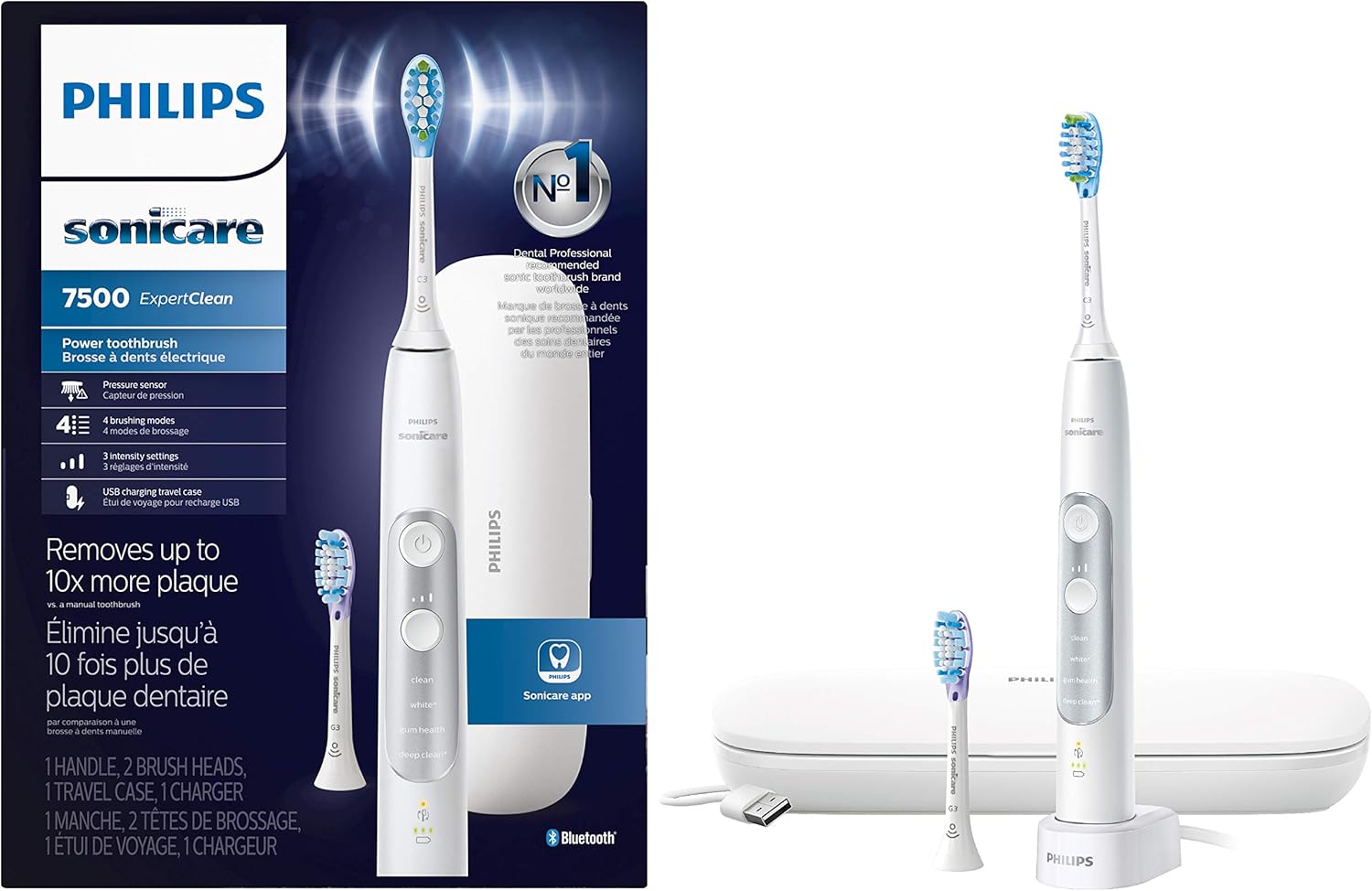
Out of the box, the ExpertClean 7500 looks like a fairly standard higher-end Sonicare kit, but there are a few things worth noting. You get the handle, at least one Premium brush head (mine came with a gum-focused one), the standard Sonicare charging base, and a hard travel case that doubles as a charging case with a USB cable. There’s also the usual quick-start guide and app prompts, which I mostly ignored after pairing it once.
The handle itself is fairly slim and not overly heavy, which I appreciate. Some Oral-B models I’ve tried feel chunkier and more plasticky. The 7500 has a clean white finish with a power button plus a separate mode/intensity control. The front LEDs show you which of the four modes you’re on (Clean, White+, Gum Health, DeepClean+) and which intensity level you’re using, plus a small indicator for the BrushSync feature that warns you when the head is due for replacement.
One thing I liked is that you can change the mode and intensity before you actually start brushing. On some cheaper models, you have to cycle through while the brush is already buzzing in your mouth, which is annoying. Here, you can set it up, then hit the power button and go. The brush also gives you the standard 2-minute timer with 30-second quad pacer, so you know when to switch quadrants of your mouth.
Overall, the package feels complete: everyday charging base for home, USB travel case for trips, and the core features (pressure sensor, BrushSync, modes) are all there. No pile of useless accessories, but also nothing really missing. For the price, I think they could have thrown in an extra brush head or two, especially since genuine Sonicare heads are not cheap, but at least what you get is coherent and usable right away.
Effectiveness: does it actually clean better?
This is where the ExpertClean 7500 justifies its price a bit. After about a week of using it twice a day, my teeth consistently felt smoother and cleaner than with my older mid-range Sonicare and my backup Oral-B. You really notice it when you run your tongue along the back of your front teeth and along the gumline. The brush claims up to 10x more plaque removal versus manual; I can’t measure that, but compared to a manual brush, the difference in smoothness is obvious.
The four modes are not just a label shuffle. Here’s how I ended up using them in practice:
- Clean: my default for everyday use, 2 minutes, straightforward.
- White+: slightly more intense, feels like it focuses a bit more on polishing surfaces; I use it a few times a week at night.
- Gum Health: extends the brushing slightly and focuses on the gumline; helpful if your gums bleed easily.
- DeepClean+: longest and strongest; good if you’ve skipped a session or eaten something sticky and gross.
Another part of the effectiveness is the timing and pacing. The 2-minute timer with 30-second quadrant alerts sounds basic, but it does change your habits. Before, I’d often rush through brushing, especially in the morning. With this, I actually wait for the little pause before switching areas. It’s a small thing, but over time it means you’re actually giving each part of your mouth some attention. My gums felt less irritated after a week or so, probably because I wasn’t over-scrubbing the same spots.
I did try the app briefly. It can give you a progress report and some coaching, but for me it was more of a novelty. I don’t want my phone involved every time I brush my teeth. The good news is the brush is still fully effective without ever using the app. So on pure cleaning performance, I’d say it’s noticeably better than basic electric brushes and manual brushing, and roughly on par or slightly ahead of high-end Oral-B in terms of cleanliness, though Oral-B still feels better at polishing the surface if that’s your priority.
Pros
- Strong cleaning performance with multiple useful modes and 3 intensity levels
- Effective pressure sensor that helps stop you from brushing too hard
- Long battery life with convenient USB charging travel case
Cons
- High upfront price, especially at full retail
- Replacement brush heads are relatively expensive over time
Conclusion
Editor's rating
The Philips Sonicare ExpertClean 7500 is a solid, well-rounded electric toothbrush that actually feels like a real upgrade over cheaper models, especially if you’ve been using an older Sonicare or a basic Oral-B. The cleaning performance is strong, your teeth feel very smooth after brushing, and the pressure sensor plus multiple modes make it easier to take care of your gums without overdoing it. Battery life is good enough that you barely think about charging, and the travel case with USB charging is genuinely handy if you’re on the road a lot.
It’s not perfect. The price is on the high side, especially at full retail, the app is mostly a gimmick for many people, and the ongoing cost of genuine brush heads adds up over time. The travel case magnet closure could be more secure, and if you just want a simple electric brush, this is probably more than you need. But if you’re the kind of person who wants more control over intensity and modes, tends to brush too hard, or has early gum issues, this model makes more sense than a bare-bones one.
I’d recommend the ExpertClean 7500 to adults who already use or plan to use an electric brush daily and are willing to spend a bit more for better comfort and features. It’s also a good pick if your dentist is on your case about plaque and gum health and you’re ready to actually fix your brushing habits. If you’re on a tight budget or don’t care about modes, pressure sensors, or travel charging, you can save money with a simpler Sonicare or an entry-level Oral-B and still get decent results.
![Sonicare 5500 Electric Toothbrush, Sonic Toothbrush with 2 Modes, Pressure Alert, EasyStart, SmarTimer and BrushPacer, Navy, Model HX7113/01 [New Technology] Sonicare 5500, Navy, Travel Case](https://www.electric-toothbrush-guru.com/storage/1025316/conversions/71vNjog50vL._AC_SL1500_-medium.webp)