
Summary
Editor's rating
Value for money: solid brush, expensive ecosystem
Design: simple, clean, but that head is not small
Battery life and charging: not bad, but not the longest either
Comfort in the mouth: smooth vibrations, but the head size matters
Build quality and long-term feel
What you actually get for your money
Cleaning performance: does it actually make your teeth feel cleaner?
Pros
- Smooth, effective clean with less harsh vibration than older Oral-B models
- Useful pressure sensor and 2-minute timer help protect gums and improve brushing habits
- Slim, comfortable handle with simple controls and decent battery life
Cons
- Brush head is quite large and can be awkward for small mouths or strong gag reflex
- iO replacement heads are expensive, increasing long-term cost
- Barebones package (one head, no travel case, 2-pin charger only) for the price

Specifications
View full product page →| Brand | Oral-B |
A mid-range electric brush that feels a bit more “pro”
I’ve been using the Oral-B iO3 for a few weeks now, after years of bouncing between cheap Oral-B basics and a Philips Sonicare. I went for this one because I wanted something a bit better than the entry-level models, but I wasn’t interested in paying extra for Bluetooth, apps, and all that nonsense. Just a brush that cleans well, lasts on battery, and doesn’t chew my gums to bits.
Out of the box, it’s pretty straightforward: one pink handle, one brush head, a 2‑pin charger, and that’s it. No travel case, no extra heads, no bonus stuff. So you’re basically paying for the handle tech and the iO head system. My first impression after the first brush was that it feels more polished than the classic Oral-B Pro models: the vibrations are smoother, and the pressure sensor light is actually noticeable while you brush.
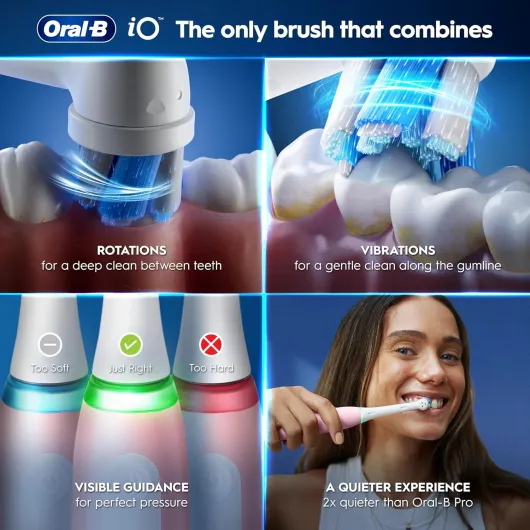
Compared to a manual brush, it’s obviously a big step up. Compared to my older Sonicare, the feeling is different: the iO3 has that typical Oral-B round head with an oscillating-rotating motion plus micro‑vibrations. It feels more like it’s scrubbing each tooth individually rather than buzzing across the whole row of teeth. After a couple of days, I got used to it and my teeth did feel cleaner along the gumline, especially at the back.
Overall, this is not some miracle gadget, but it’s a pretty solid everyday toothbrush. It has a few quirks and it’s not cheap once you factor in the replacement heads, but if you’re moving up from a basic electric or from manual, it does feel like an upgrade. The rest of this review is basically the honest breakdown of what works and what’s a bit annoying in day‑to‑day use.
Value for money: solid brush, expensive ecosystem
Value is where the Oral-B iO3 gets a bit tricky. On sale or with a voucher, it feels like good value for money: you get a clearly better brushing experience than a basic electric brush, smoother vibrations, pressure sensor, and a modern design. That’s exactly what one Amazon reviewer hinted at: they were happy because they got it with a voucher and on offer, but weren’t sure they’d keep it at full price. I’m in the same boat: discounted, it’s a solid deal; at full retail, you really have to want the iO system.
The main hidden cost is the replacement heads. The iO heads are more expensive than normal Oral-B heads, and you’re meant to replace them every three months. If you’re buying for a couple or a family and everyone uses iO heads, the ongoing cost jumps pretty quickly. So even if the handle itself isn’t crazy expensive, the total cost of owning this thing over a few years is higher than with some other brushes. That’s worth thinking about before you commit to the iO line.
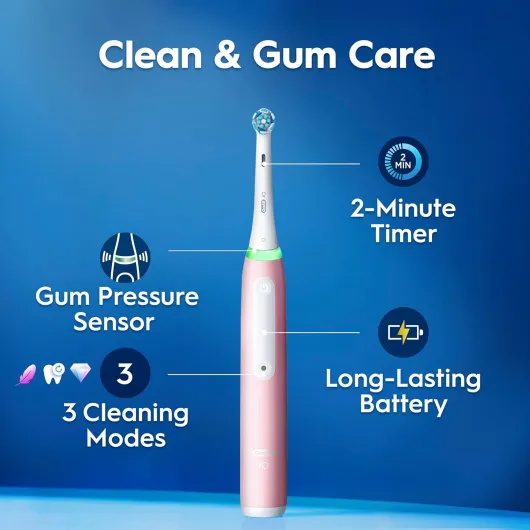
On the positive side, you’re not paying for stuff you might not use, like Bluetooth and smartphone apps. The iO3 skips those and focuses on the basics: 3 modes, pressure sensor, 2‑minute timer, and a decent motor. If that’s all you care about, then you’re not wasting money on gimmicks. But if you compare it to cheaper Oral-B Pro models, those will still clean your teeth pretty well for less money and with cheaper heads. The iO3 feels nicer and more refined, but it doesn’t suddenly double your dental health.
So in terms of value, I’d say: good if you catch it on offer and you’re okay with the head prices. If budget is tight and you just want a basic upgrade from manual, a lower-end Oral-B or Philips Sonicare might make more sense. This one sits in that mid‑range where you pay extra for a nicer feel and slightly better tech, but you definitely notice it in your wallet over time.
Design: simple, clean, but that head is not small
Design-wise, the Oral-B iO3 sits in a nice middle ground. The handle is slim and lightweight (around 440 g for the whole package, so the handle itself feels light in hand), and it’s easy to hold even when your hands are wet. There’s a soft matte feel to the plastic that gives enough grip without feeling rubbery or sticky. It doesn’t have loads of grooves or ridges, which is good because it’s easier to wipe clean and doesn’t trap dried toothpaste everywhere.
The main design talking point is the large round brush head. It’s bigger than older Oral-B heads and also feels bulkier than most Sonicare heads I’ve used. For me, after a couple of days, it was fine, but I did notice that getting behind the last molars took a bit more effort. If you’ve got a small mouth, crowded teeth, or a strong gag reflex, this could be a real downside. One Amazon reviewer basically said the same: if you already struggle with normal Oral-B heads, this one probably won’t help.
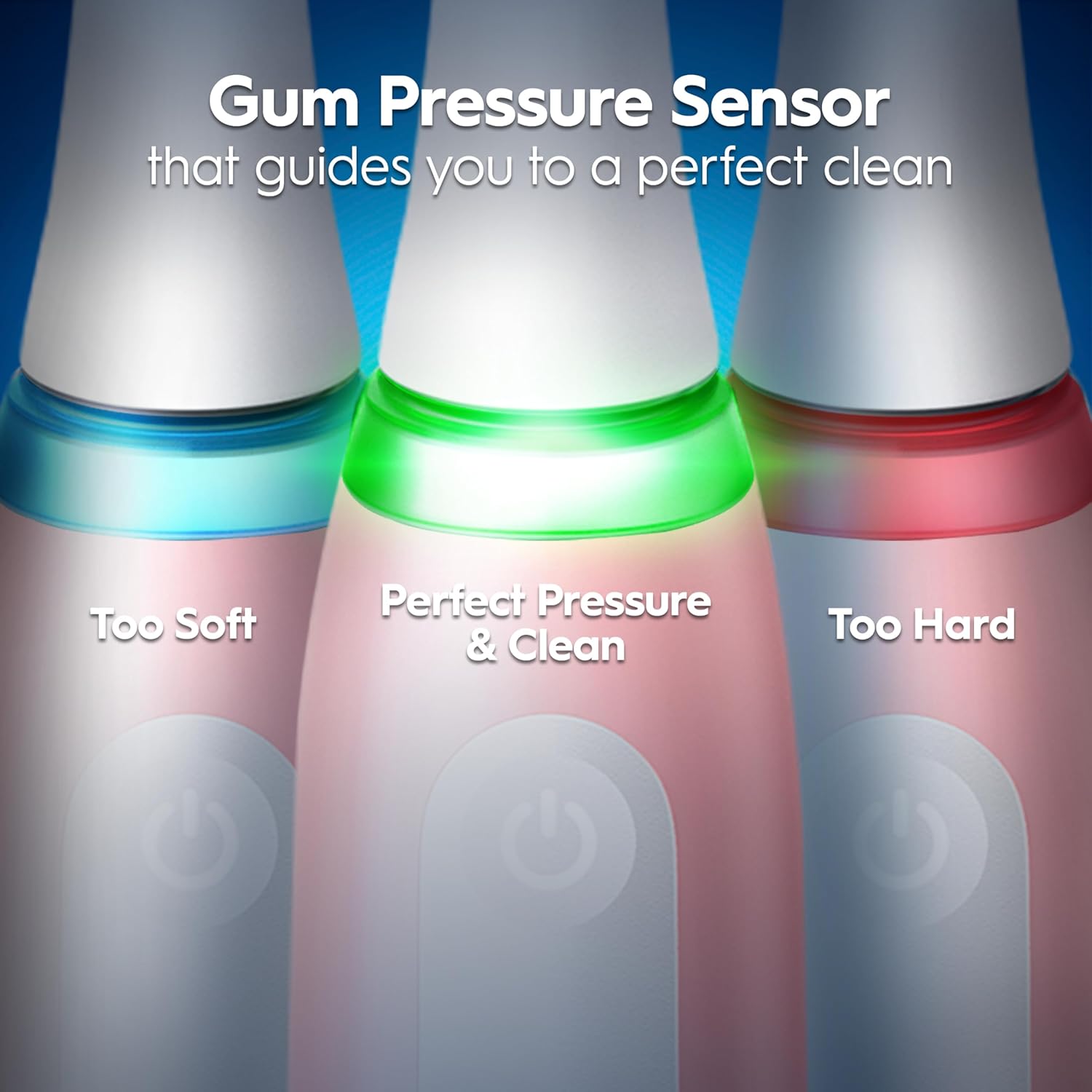
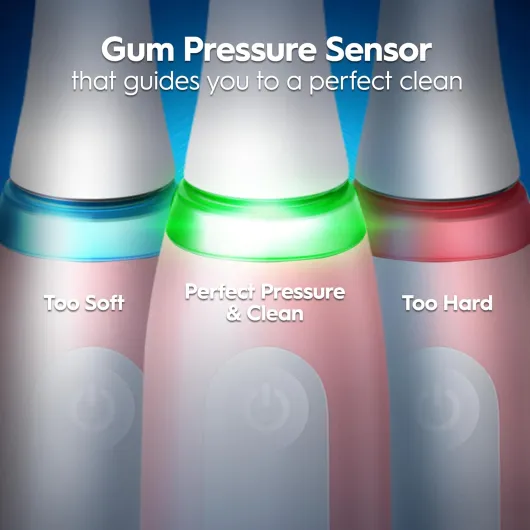
The light ring pressure sensor around the neck is actually useful. It glows when you press too hard, and you can see it easily in the mirror while brushing. It’s not ultra precise – sometimes your cheek or lip pushing against the head can set it off – but it’s good enough to remind you not to scrub like you’re cleaning a pan. The single button for everything is okay but not perfect. You have to cycle through the modes by tapping, so if you overshoot the one you want, you loop back around. No individual mode icons, just a small light, so you kind of learn by feel which click pattern is which.
Visually, the brush looks modern without being over the top. No screen, no stupid glowing animations, just a coloured handle with a light ring. If you like simple gadgets that do their job without screaming for attention, you’ll probably like this design. If you want something that feels high‑tech with a display and more control, this stripped-back version may feel a bit basic for the price.
Battery life and charging: not bad, but not the longest either
Battery life on the Oral-B iO3 is decent. In my case, brushing twice a day for 2 minutes, I got a bit over two weeks on a single charge before the power started to dip. That lines up fairly well with what some Amazon reviewers said (one mentioned around 8 weeks with just two charges, which sounds like they weren’t letting it run all the way down each time). It’s not the absolute longest-lasting brush I’ve used, but for normal home use, it’s fine. You’re not charging it every couple of days, which is what matters.
The charging base is a simple 2‑pin UK bathroom-style charger. No USB, no travel-friendly option. If your bathroom doesn’t have a 2‑pin shaver socket, you’ll need a 2‑pin to 3‑pin adapter. That’s pretty standard for electric toothbrushes, but still, it would be nice to have USB these days. Charging itself takes a while – it’s not a quick 30‑minute top-up. You’re looking at several hours to go from nearly empty to full, so the easiest approach is to just leave it on the stand overnight when the battery starts getting low.
There’s a simple indicator light to show battery status, but it’s not ultra detailed. You kind of learn to read it over time: when the power starts to feel a bit weaker and the light warns you, you know it’s time to charge. In practice, I never completely ran it flat by accident. As long as you pay a bit of attention, you won’t suddenly end up with a dead brush in the morning.
So overall, battery and charging are fine but nothing special. It’s good enough for daily use and the odd weekend away if you charge it beforehand, but for longer trips you’ll probably want to bring the charger. If you’re used to Sonicare models that can last three weeks or more, this might feel like a small step down. But for most people, plugging it in every couple of weeks is hardly a big deal.
Comfort in the mouth: smooth vibrations, but the head size matters
Comfort was one of the main reasons I wanted to try this iO3. Older Oral-B models sometimes felt a bit rough on my gums, almost like the head was rattling rather than gliding. With the iO3, the micro‑vibrations are smoother, and the whole brushing experience feels less harsh. One thing I noticed after a few days is my gums weren’t as tender as they sometimes got with cheaper Oral-B models, especially when I accidentally pressed too hard.
The flip side is still that larger head. For the front and middle teeth, it’s fine, and the round shape really does make it easy to sit the head on each tooth. But when you try to get right to the back, especially on the inside surfaces, it can feel like you’re shoving a bit too much plastic into your mouth. If you have a strong gag reflex, I would genuinely think twice about this. One of the Amazon reviews mentioned this pretty clearly, and I think they’re right: for some people, it might be a dealbreaker.
The pressure sensor helps with comfort too. When the light goes red, you know you’re pushing too hard, which is useful if you’re the kind of person who thinks more pressure means cleaner teeth. Over a couple of weeks, I noticed I naturally eased up and let the brush do the work. That probably explains why my gums felt better and less sore. The Sensitive mode also tones down the intensity a bit, which is handy if your gums are inflamed or you’ve just had dental work done.
Noise-wise, it’s not silent, but it’s less rattly than older Oral-B models. It’s a mid‑level hum rather than a loud buzz. If someone’s sleeping in the next room with the door closed, it’s not going to wake them. In day-to-day use, I’d rate the comfort as pretty solid: smooth vibrations, easy-to-hold handle, but with a head that won’t suit everyone. If your mouth is on the smaller side, I’d try to see one in person before committing if possible.
Build quality and long-term feel
I’ve only had a few weeks with the iO3, so I can’t pretend I’ve stress‑tested it for years, but I can comment on the general build quality. The handle feels sturdy and well put together. There are no creaky parts or loose panels, and the button has a firm, consistent click. The matte plastic doesn’t scratch easily, at least not in normal bathroom use; I’ve knocked it over a couple of times and it survived without any marks or cracks.
One thing I pay attention to with electric brushes is how easy they are to keep clean. The iO3 does fairly well here. The area around the neck where the head attaches can collect a bit of gunk if you never rinse it, but if you follow the advice of removing the head and rinsing after each use, it stays in good shape. One Amazon reviewer pointed this out as well: take the head off and rinse the connection if you want it to last and avoid that dried toothpaste buildup that looks gross and can potentially affect performance over time.
The heads themselves click on firmly and don’t wobble. The seal between the head and handle feels tight, which gives me a bit more confidence about water resistance over time. It’s made in Germany, and it does have that solid, no‑nonsense feel you usually get from Oral-B gear. I’ve had older Oral-B handles last 5+ years with zero issues, so I’d expect something similar here, though of course the internal battery will eventually degrade like any rechargeable device.
The weak point in terms of long‑term cost isn’t really durability of the handle, it’s the price of the iO replacement heads. They’re noticeably pricier than standard Oral-B heads, and you’re supposed to change them every three months. If you actually stick to that schedule, the ongoing cost adds up. So durability of the hardware seems good, but you do need to budget for heads if you’re planning to use this for several years.
What you actually get for your money
In the box, you get the bare minimum: one handle, one Ultimate Clean iO brush head, and a 2‑pin charging base. No travel case, no extra heads, no wall adapter. If you only have 3‑pin sockets in your bathroom, you’ll need to buy a separate adapter, which is a bit annoying but fairly standard for electric toothbrushes in the UK. The packaging itself is a simple cardboard box with a plastic insert, nothing fancy but it protects the brush well enough.
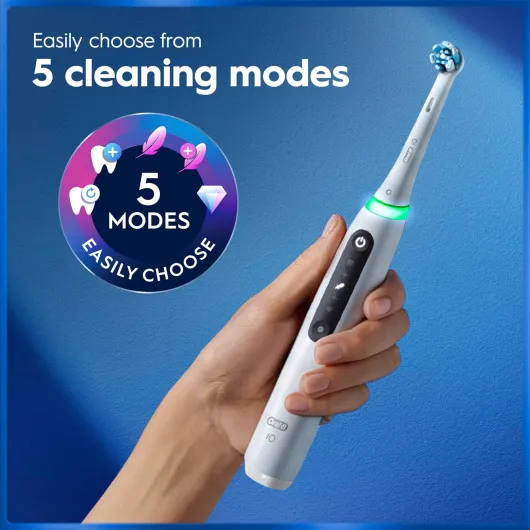
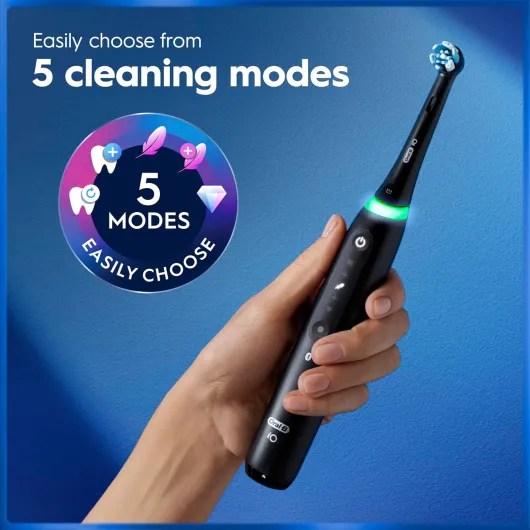
The model I tried is the pink version, which is more of a muted, slightly glossy pink rather than something flashy. It’s clearly unisex, but you do have to be okay with a coloured handle; this isn’t the discreet white or black you might be used to. On the front, there’s a single main button and a light ring around the top that doubles as the pressure sensor and status indicator. You cycle through the three modes (Daily Clean, Sensitive, Whitening) by pressing the button multiple times; there’s no screen like on the more expensive iO models.
The brush head is the iO Ultimate Clean head, which is noticeably larger than the older Oral-B round heads. If you already struggle with gag reflex or getting a brush to the very back molars, this is worth knowing. One Amazon reviewer mentioned this clearly and I agree: it’s not tiny, and it can feel a bit bulky in a small mouth. Also, these iO heads are pricier than standard Oral-B heads, so the running cost is higher. You’re supposed to change them every three months, and your wallet will definitely feel that over time.
So in terms of presentation, it’s pretty no‑nonsense. It looks like a mid‑range product, not cheap, but you’re not drowning in accessories either. You’re basically paying for the iO motor and pressure sensor tech. If you want a more complete bundle with spare heads and a case, this specific package is a bit barebones for the price. But if you just want to get into the iO line without going all the way up to the iO6–iO10, this is the stripped‑down way to do it.
Cleaning performance: does it actually make your teeth feel cleaner?
On pure cleaning performance, the Oral-B iO3 is honestly pretty good. After the first couple of brushes, I noticed that “just left the dentist” smoothness, especially along the gumline and around the back teeth. The combination of the oscillating-rotating motion and the micro‑vibrations does a solid job of breaking up plaque. Compared to my old Sonicare, the feeling is more targeted: you can feel the brush working each tooth individually instead of just buzzing across a whole section.
There are three modes: Daily Clean, Sensitive, and Whitening. In practice, I ended up using Daily Clean 90% of the time. Sensitive is handy if your gums are feeling a bit rough or if you’re new to electric brushing and want to ease in. The Whitening mode feels slightly more intense and seems to focus more on the front surfaces. I wouldn’t say my teeth got dramatically whiter, but surface stains from coffee and tea did seem slightly reduced after a couple of weeks. Nothing dramatic, but enough that my teeth looked a bit less dull.
The built‑in 2‑minute timer with 30‑second quadrant alerts is standard but still useful. It nudges you to actually spend enough time on each part of your mouth instead of rushing. I found that following the timer and just slowly moving the head from tooth to tooth gave the best results. If you rush and scrub like a manual brush, you’re not really using the tech properly. After about a week of doing it properly, my gums looked less red in a couple of spots where I usually miss with a manual brush.
Overall, in terms of effectiveness, I’d say it’s better than a basic electric and clearly better than a manual brush. If your dentist has been telling you to switch to an electric brush and you’re actually going to use it twice a day, this one will get the job done well. Just don’t expect miracle whitening – it’s more about consistent, thorough cleaning and gentler treatment of your gums if you pay attention to the pressure sensor.
Pros
- Smooth, effective clean with less harsh vibration than older Oral-B models
- Useful pressure sensor and 2-minute timer help protect gums and improve brushing habits
- Slim, comfortable handle with simple controls and decent battery life
Cons
- Brush head is quite large and can be awkward for small mouths or strong gag reflex
- iO replacement heads are expensive, increasing long-term cost
- Barebones package (one head, no travel case, 2-pin charger only) for the price
Conclusion
Editor's rating
The Oral-B iO3 is a pretty solid everyday electric toothbrush if you want something more refined than the cheap models but don’t care about apps and screens. The cleaning performance is good, the vibrations are smoother than older Oral-B brushes, and the pressure sensor actually helps you stop over‑scrubbing your gums. After a couple of weeks, my teeth felt cleaner around the gumline and my gums were less irritated, especially once I stopped pushing so hard and let the brush do the work.
It’s not perfect, though. The brush head is on the large side, which can be a problem if you’ve got a small mouth or a strong gag reflex. The handle doesn’t come with many extras – no travel case, just one head – and the iO replacement heads are expensive, so the real cost shows up over the long term. Battery life is decent but not outstanding, and the 2‑pin charger without a USB option feels a bit dated.
I’d say this brush is well suited to adults who already know they like Oral-B’s round heads, want a smoother, slightly more premium feel, and are willing to pay a bit extra for it. If you’re neurodivergent or sensitive to harsh vibrations, this is gentler than older models and could be worth it for comfort alone. On the other hand, if you’re on a tight budget, hate bulky brush heads, or don’t want to commit to pricey replacement heads, you’re probably better off with a cheaper Oral-B Pro model or a basic Sonicare. Good brush, but the price and head size keep it from being an automatic buy.
![Sonicare 5500 Electric Toothbrush, Sonic Toothbrush with 2 Modes, Pressure Alert, EasyStart, SmarTimer and BrushPacer, Navy, Model HX7113/01 [New Technology] Sonicare 5500, Navy, Travel Case](https://www.electric-toothbrush-guru.com/storage/1025316/conversions/71vNjog50vL._AC_SL1500_-medium.webp)