
Summary
Editor's rating
Is it worth the price or just a fancy gadget?
Looks premium, but not everything is practical
Battery life and charging: strong point, but not perfect
Comfort in the mouth: powerful but needs an adjustment period
Daily use, app, and pressure sensor: what actually matters
What you actually get in the box
Does it actually clean better than a cheaper brush?
Pros
- Very effective cleaning with noticeable smoothness on teeth and improved gum feel
- Excellent battery life (around 2–3 weeks of use per charge)
- Useful pressure sensor and timer that genuinely improve brushing habits
Cons
- High price compared to mid-range electric brushes that already perform well
- App and Bluetooth features feel optional after the first weeks of use
- Smooth finish can be a bit slippery and travel case is not especially robust

Specifications
View full product page →| Brand | Philips |
A pricey toothbrush I actually wanted to test properly
I’ve been using electric toothbrushes for years, mostly mid-range Oral-B models around 50–80€. When I picked up the Philips Sonicare DiamondClean 9000 (HX9911/89, Aquamarine with 4 heads), I honestly thought, “Alright, how much better can a toothbrush really be?” The price is clearly in the high bracket, so I used it twice a day for a few weeks to see if it really did more than just look fancy on the sink.
From day one, the difference versus a manual brush is obvious, but that’s true of any decent electric. Where this one stands out is the overall feel of the clean and the way it kind of forces you into better habits: timer, pressure sensor, and the app nagging you if you skip areas. It doesn’t magically turn your teeth into a Hollywood smile, but my mouth did feel cleaner, especially between teeth and along the gums.
On the other hand, it’s not all positive. It’s expensive, the app is useful at first but quickly feels a bit gimmicky, and some design choices are more about style than practicality. Also, if you’ve never used a Sonicare before, the high-frequency vibration is a bit weird for the first few days – it tickles and can feel too strong on sensitive teeth until you get used to it.
So this isn’t some miracle gadget, but it’s also not just hype. It’s a solid high-end brush with some smart features, but you really have to decide if the extra cost over a more basic electric brush makes sense for you. I’ll break down what worked for me and what clearly could be better.
Is it worth the price or just a fancy gadget?
This is where things get a bit more nuanced. The DiamondClean 9000 is not cheap, especially compared to basic electric brushes that already do a decent job. You’re paying for the brand, the design, the extra modes, the app, and the premium heads. So the question is: do you actually feel that value in daily use? Partly yes, partly no.
On the plus side, you get 4 brush heads in the box, which is not always the case at this level. That already saves some money in the first year. The cleaning performance is strong, the battery life is great, and the pressure sensor + timer genuinely help you brush better. If you’ve had gum issues, braces, crowns, or just want to be a bit more serious about oral care, it starts to make sense as a long-term investment rather than a gadget.
On the downside, there are mid-range models that clean almost as well for noticeably less money, especially if you don’t care about Bluetooth or detailed app stats. Also, replacement Sonicare heads are not cheap. Over several years, the total cost (brush + heads) adds up. At this price point, a slightly more robust travel case and maybe a more versatile charging option (e.g., USB-C or extra travel charger) would have made the package feel more complete.
So in terms of value, I’d say: if you’re the kind of person who keeps gadgets for years and actually uses the features (modes, app, pressure sensor), it’s good value over the long run. If you just want "an electric toothbrush that spins", you can save money and go for a simpler model without feeling like you’re missing out on something critical.
Looks premium, but not everything is practical
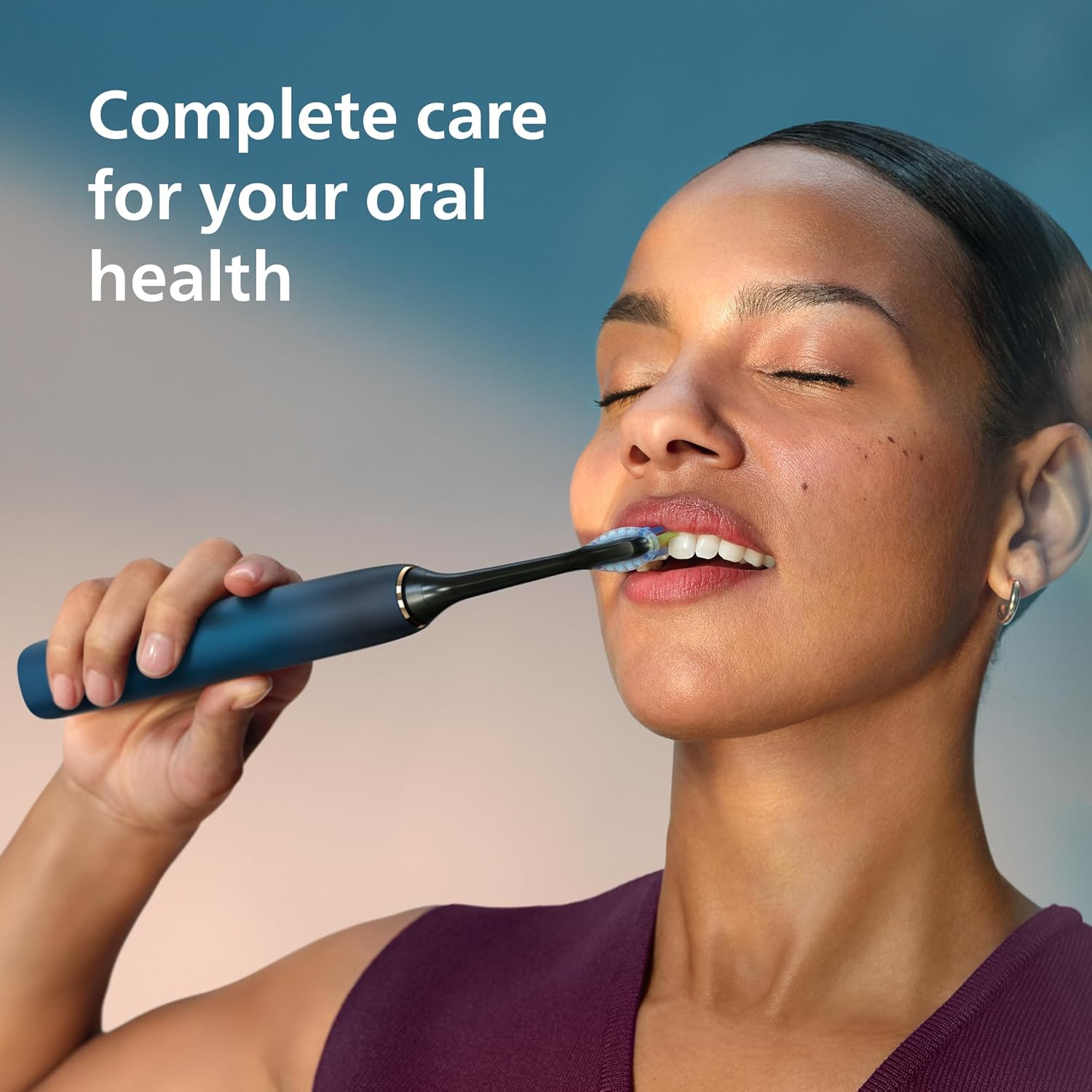
The design is clearly aimed at people who like their bathroom gear to look a bit more "premium". The Aquamarine / dark blue finish is nice, matte, and doesn’t scream “medical device” like some white plastic brushes. It has a clean cylindrical shape, no weird bulges, and the buttons are flush enough that it looks sleek, but still easy to find with your thumb when half asleep in the morning.
One thing I noticed quickly: the smooth finish looks nice but can get slippery if your hands are really wet or soapy. It’s not a disaster, but compared to some Oral-B models with rubber grips, this is more about style than grip. If you have small or very dry hands, you’ll probably be fine. If you tend to rush and have toothpaste everywhere, you might have to be a bit more careful.
The indicator lights for modes and intensity are clear enough, but they’re small and low-contrast. Once you’ve set it up once, you’ll probably just leave it on the same mode and forget about it, so it’s not a big issue. Still, for a device you use half-awake, I’d prefer slightly more obvious icons or backlighting. The Bluetooth light is just there to remind you the app is connected – nice, but you don’t really need to look at it often.
The charger puck is compact and looks good on a counter, but it’s still a separate base plus cable – no USB-C directly on the handle, which would have been more convenient in 2026. The travel case design is decent but not ultra-robust; I would call it "fine for a backpack, not ideal for being crushed in a suitcase under heavy stuff". In short: nice design, a bit style-first, but nothing that breaks the product.
Battery life and charging: strong point, but not perfect
Battery life is one of the main strengths here. With twice-daily brushing at around 2–3 minutes each, I was getting roughly 2 to 3 weeks on a full charge. That’s with Bluetooth occasionally connected and using mostly Clean and White+ modes. I didn’t bother to squeeze every last second out of it, but it easily covered a long work trip without needing the charger.
Charging is done via the small charging puck that connects to the base. You just drop the handle onto it and it starts charging. The LED indicator on the handle shows when it’s low and when it’s charging. From almost empty to full, it took around a few hours – I usually just left it overnight and it was done. There’s no fast-charging feature as such, but for a toothbrush, you don’t really need it as long as the battery doesn’t die suddenly mid-brush, which it didn’t.
One thing I would have liked in 2026 is USB-C directly on the handle or travel case. You still need to bring the specific charger and cable if you travel for more than 2–3 weeks. Not a big deal for most, but when other devices are moving to standard ports, this feels a bit behind. Also, the charger is not super compact in terms of height – it’s fine on a bathroom counter, slightly annoying if you’re tight on space or sharing a sink.
Still, overall battery performance is clearly above average. If you hate constantly charging your brush, this one is good. You can basically forget about the battery for weeks, which is exactly what you want in day-to-day use. I’d rate the battery experience as very solid, with room for improvement on charging convenience.
Comfort in the mouth: powerful but needs an adjustment period
In terms of comfort, there are two things: how it feels in your hand and how it feels in your mouth. In the hand, the slim handle is comfortable and light, so even a long 3–4 minute Deep Clean+ session doesn’t feel tiring. The lack of rubber grip is noticeable but not a deal-breaker. I never dropped it, but I did feel it twist a bit once when my hand was really soapy.
In the mouth, if you’re new to sonic-style brushing (as opposed to oscillating-rotating heads like many Oral-B), the first three or four uses are a bit strange. The 62,000 movements per minute give a buzzing / tickling feeling, especially on the front teeth and near the gums. The first two days I found it slightly uncomfortable on maximum intensity, so I dropped it to level 1 or 2 until I got used to it. After about a week, I actually liked the sensation and going back to a cheaper electric felt kind of rough and noisy.
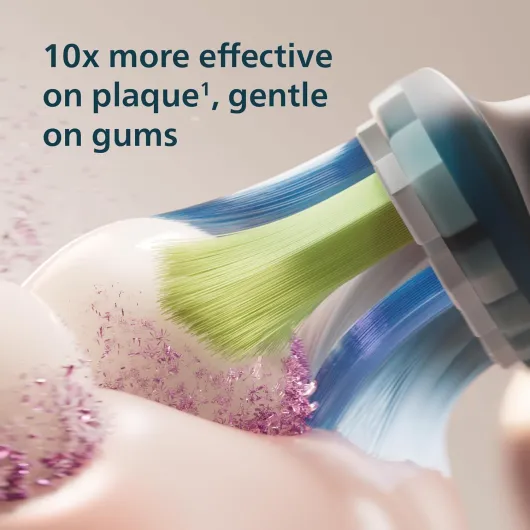
The C3 Premium Plaque Control heads are medium firmness. For me, that was fine, but if you have very sensitive gums, I’d say stick to the lower intensity and maybe consider a softer head later. The pressure sensor is actually useful: when you push too hard, the handle does a gentle pulsing that you quickly learn to recognize. It’s not loud or annoying, just a little "hey, chill" reminder. It helped me stop scrubbing like I do with a manual brush.
Noise-wise, it’s quieter than many oscillating brushes. It’s more of a high-pitched hum than a loud mechanical noise. If you share a bathroom or brush when someone’s asleep, this is a plus. Overall, comfort is good once you get past the first few days. There’s a small learning curve, but after that, it feels natural and not tiring to use twice a day.
Daily use, app, and pressure sensor: what actually matters
On a daily basis, the performance is consistent. You press the button, it starts instantly, no weird delays or glitches. It remembers your last mode and intensity, which is good because most people won’t want to fiddle with settings every morning. The motor doesn’t seem to lose power midway through a brushing session, even when the battery is getting low – it keeps full strength until it needs a recharge.
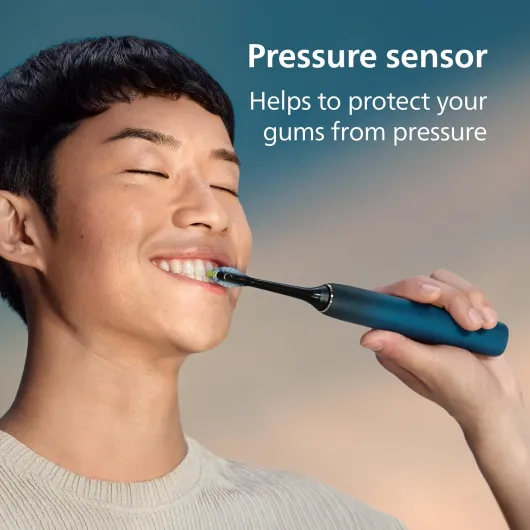
The pressure sensor is probably the most useful feature after the basic brushing power. It’s not a loud beep or bright light; instead, the handle makes a slight pulsing motion and you feel it in your hand and mouth. It kicked in quite often the first week, which was a bit of a reality check about how hard I used to brush. After that, it happened less and less because I automatically used a lighter touch. If you tend to scrub aggressively, this is genuinely helpful.
Now, the app. The Sonicare app connects via Bluetooth and gives you coaching and progress reports. At the beginning, it’s kind of fun: it shows zones, reminds you if you skipped areas, and logs your brushing streak. After about 10 days, I personally stopped checking it every day. It’s nice for getting into better habits or if your dentist told you to be more serious about your brushing, but for most people, it will end up as a "set and forget" thing. It’s not bad, it’s just not essential once you know how to brush properly.
Overall performance: solid, predictable, and easy to live with. No random disconnects that affect brushing, no weird vibrations, and the different modes actually do feel different. The tech features are more about discipline than raw power, but that’s not a bad thing for an everyday routine.
What you actually get in the box
Out of the box, you get the DiamondClean 9000 handle, 4 x C3 Premium Plaque Control brush heads, a charging base with a little puck, a travel case, and the usual manual and warranty stuff. No separate fancy glass charger in this edition, just the puck-style charger that looks neat and doesn’t take much space on the sink. Everything comes packed in a solid cardboard box; nothing looks cheap, which is expected at this price.
The handle itself is quite slim and light. It’s not bulky, and if you’re used to older chunky electric brushes, this feels more modern. The 4 brush heads are a big plus: with many premium brushes you only get one head and then you’re forced to buy extra heads almost immediately. Here, you can easily cover several months of use, or share the handle with a partner if you buy extra colour rings or just agree on who uses which head.
On the front of the handle, you’ve got the power button, a mode button, and small icons for the 4 modes: Clean, White+, Gum Health, and Deep Clean+. There are also 3 little LEDs for the intensity levels. It’s pretty straightforward: you tap through until you get the combo you like, and it remembers the last setting you used. There’s also a Bluetooth icon that lights up when it’s connected to the app.
Overall, in terms of what you get, it’s pretty solid but standard for this range: brush, charger, travel case, and multiple heads. No crazy accessories, but nothing essential is missing either. For a high-end brush, I would have liked a slightly more protective or rigid travel case and maybe a second charger for travel, but that’s nitpicking. Still, at this price level, you do start to compare it to what competitors throw in the box.
Does it actually clean better than a cheaper brush?
This is the real question: is the clean noticeably better than a regular electric toothbrush? For me, yes, but with a few details. After a few days, I noticed that my teeth felt smoother when I ran my tongue over them, especially on the inner surfaces that I usually neglect. The sonic motion really seems to push fluid between teeth and along the gumline. I didn’t have any professional plaque measurements done, but by feel alone, my mouth felt cleaner than with my older Oral-B mid-range model.
The 4 modes are not just marketing labels. Here’s how I ended up using them most of the time:
- Clean: my go-to for everyday, 2-minute standard routine.
- White+: slightly longer and more focused on polishing the front teeth; I used it when I had more tea/coffee stains.
- Gum Health: softer, longer on the gumline, nice if your gums are a bit irritated.
- Deep Clean+: longer and more thorough; good when you feel you’ve been lazy for a day or two.
The built-in timer and pacing (it pauses briefly every 30 seconds to tell you to move to the next quadrant) really help you cover the whole mouth. I used to rush certain areas, but with this, I actually let the timer guide me. After around two weeks, I noticed less bleeding when flossing, which for me is a sign that gum health improved a bit. It won’t fix bad flossing habits, but it clearly helps.
Is it dramatically better than a 50–70€ electric brush? Not dramatically, but it is better. The combination of the strong sonic action, the quality of the heads, and the pressure sensor pushed me to brush more gently but more thoroughly. If your current brush is old, weak, or you’re still on manual, the jump in effectiveness is noticeable. If you already have a good recent electric, the improvement is more "nice upgrade" than "night and day".
Pros
- Very effective cleaning with noticeable smoothness on teeth and improved gum feel
- Excellent battery life (around 2–3 weeks of use per charge)
- Useful pressure sensor and timer that genuinely improve brushing habits
Cons
- High price compared to mid-range electric brushes that already perform well
- App and Bluetooth features feel optional after the first weeks of use
- Smooth finish can be a bit slippery and travel case is not especially robust
Conclusion
Editor's rating
The Philips Sonicare DiamondClean 9000 is a solid high-end electric toothbrush that genuinely cleans well and pushes you toward better brushing habits. The combination of strong sonic action, multiple modes, a clear timer, and a useful pressure sensor makes daily brushing more structured and effective. Battery life is excellent, the brush is comfortable once you get used to the sonic feel, and the included 4 brush heads are a nice touch that many competitors skip.
It’s not perfect though. The price is high, the app is more "nice to have" than essential after the first couple of weeks, and some design choices lean more toward style than pure practicality. The grip could be better, the travel case could be tougher, and having a more universal charging solution would make it more travel-friendly. If you already own a good mid-range electric toothbrush, the jump in performance is noticeable but not mind-blowing; it’s an upgrade, not a revolution.
So who is it for? People who care about oral health, want a premium-feeling brush, and are ready to invest in something they’ll use every day for years. Also good if you tend to brush too hard and need help protecting your gums. Who should skip it? Anyone on a tight budget, or those who don’t care about extra modes and apps and just want a basic electric brush that gets the job done. Overall, it’s a very capable, but not flawless, premium toothbrush.
![Sonicare 5500 Electric Toothbrush, Sonic Toothbrush with 2 Modes, Pressure Alert, EasyStart, SmarTimer and BrushPacer, Navy, Model HX7113/01 [New Technology] Sonicare 5500, Navy, Travel Case](https://www.electric-toothbrush-guru.com/storage/1025316/conversions/71vNjog50vL._AC_SL1500_-medium.webp)